Sleep apnea is a condition in which a person repeatedly stops breathing while they sleep for about 10 seconds. Its effect on sleep quality is astronomical.
Sleep apnea is one of the leading causes of insomnia in adults over age 40. If you’re eligible for Medicare and have trouble sleeping, you may want to know, “Does Medicare cover sleep apnea?”
Medicare coverage for sleep apnea starts with Part B, and it includes some of the costs related to sleep apnea, such as doctor’s visits to diagnose and treat the condition.
Does Medicare Cover CPAP Machines?
Does Medicare Cover Sleep Apnea? | Medicare Plan Finder
Medicare Part B will cover a CPAP machine to help treat your sleep apnea if your doctor determines that it is medically necessary. A CPAP machine stops the airways from collapsing by sending pressurized air into the throat, allowing the user to sleep.
Medicare coverage for CPAP machines comes with a three-month trial period. You may be responsible for paying 20 percent of your CPAP rental with Medicare costs, and 20 percent of the masks and tubing costs.
If your doctor determines that the CPAP machine helps your sleeping disorder, Medicare will continue to cover your CPAP machine. Medicare will continue to pay for your CPAP rental for 13 months.
You own the machine after the rental period. If you already owned a CPAP machine before you enrolled in Medicare, you might be able to receive coverage for renting a replacement machine or accessories.
How to Get a CPAP Machine
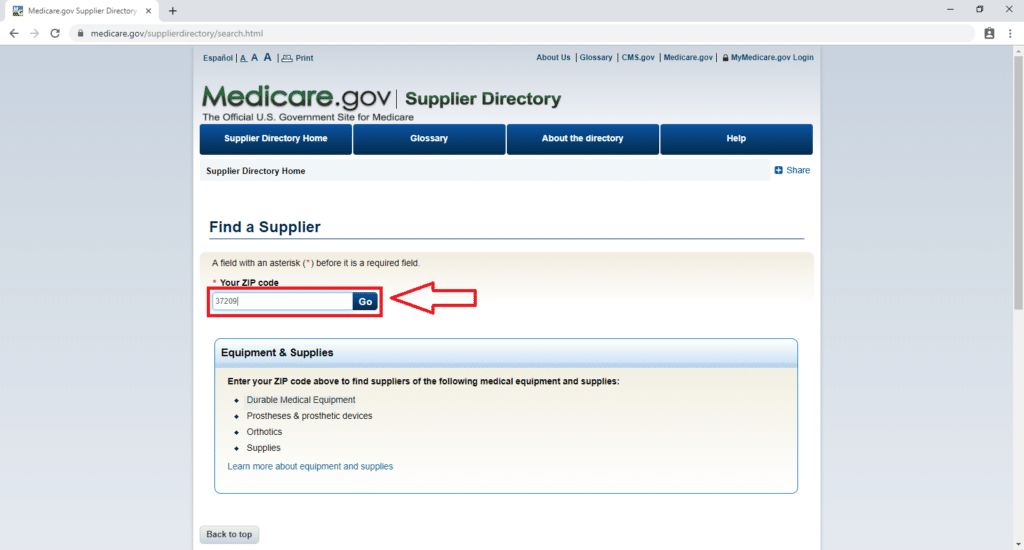
The Centers for Medicare and Medicaid (CMS) consider CPAP machines to be durable medical equipment (DME). Medicare.gov has a resource for finding DME in your area.
If you have a prescription for a CPAP machine, click here. Enter your zip code to find your nearest Medicare-approved DME provider. For demonstration purposes, we chose 37209, which is the zip code for our corporate offices in Nashville, TN.
How to Get a CPAP Machine Step 1 | Medicare Plan Finder
You will then reach a page that lists providers for many types of DME. Since we’re only going to cover CPAP machines, click the box marked “CPAP, RADs, & Related Supplies & Accessories” as shown below in red. Then click “Search” as shown below in blue.
How to Get a CPAP Machine Step 2 | Medicare Plan Finder
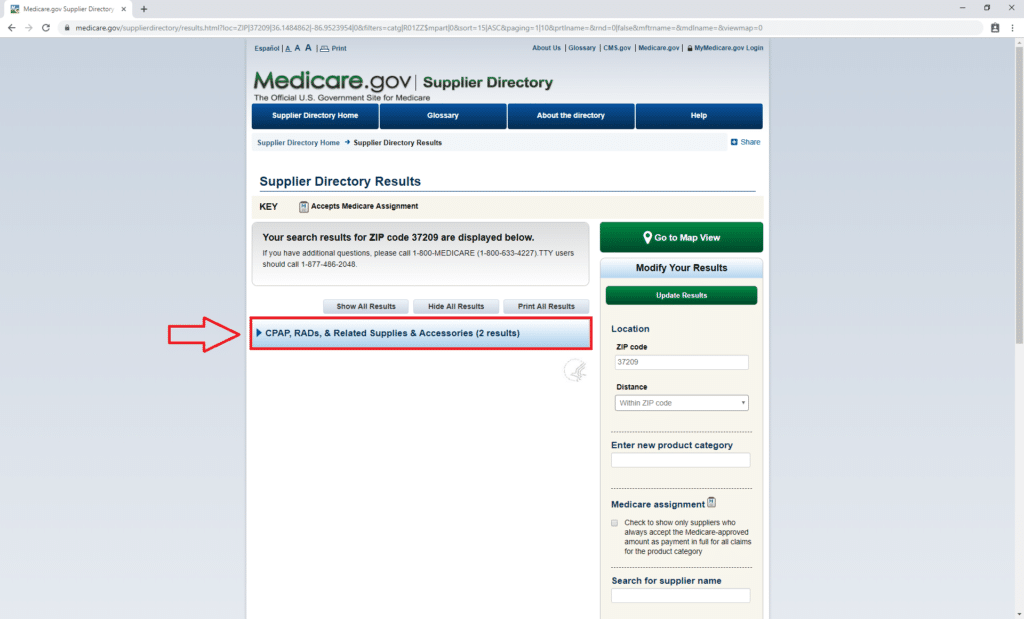
Once you do that, you will come to a page that tells you how many CPAP machine providers are in your area that looks like this. Click on the box that tells you how many local results there are.
How to Get a CPAP Machine Step 3 | Medicare Plan Finder
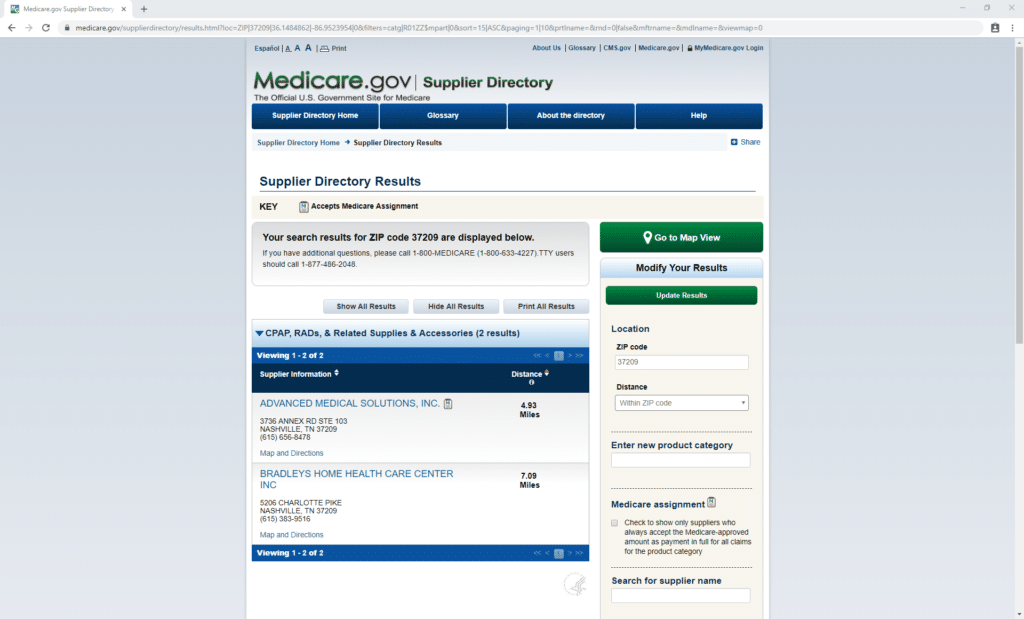
The next page will display contact information for the DME providers. Call them to discuss their services and costs. You may need to call more than one to find a good fit.
How to Get a CPAP Machine Step 4 | Medicare Plan Finder
Does Medicare Cover Sleep Apnea Equipment?
Some people may not be able to use a CPAP machine. Medicare will cover an oral appliance in that case, if your doctor prescibes one. An oral appliance holds the jaw open and allows the user to breathe by keeping the airway clear.
Does Medicare Cover Sleep Apnea Testing?
Medicare Part B will cover sleep apnea testing if your doctor orders a test for you. Medicare will typically pay for 80 percent of the associated costs after you’ve met the Part B deductible.
Sleep tests are usually performed at a sleep center or at a hospital, and the tests record your nighttime sleep patterns. The tests provide your doctor with a detailed snapshot of how you sleep, and he or she can use the results to render a diagnosis.
Medicare will cover in-home test types I-IV if you display sleep apnea symptoms. The in-home tests can only screen for sleep apnea and not for other sleep disorders.
What Else Does Medicare Cover for Sleep Apnea?
Medicare Part B is public health insurance. Its coverage is limited to what the federal government approves.
Sleep apnea affects every area of a person’s life, and patients should be treated with their overall health in mind.
Private insurance carriers offer policies called Medicare Part C (Medicare Advantage) plans that can provide coverage beyond Original Medicare. Some plans offer transportation to doctor’s appointments, meal delivery, fitness classes, and prescription drugs.
Doctors typically do not prescribe medications as a primary sleep apnea treatment, but sometimes doctors recommend drugs to help manage sleep apnea symptoms. Medicare Part D or certain Medicare Advantage plans will cover prescription drugs such as Ambien to help you sleep or Provigil to help you stay awake.
Rx Discount Card | Medicare Plan Finder
Sleep Apnea Causes
The most common form of sleep apnea is obstructive sleep apnea. It occurs when the throat muscles relax and block the airway. Throat muscles support the tongue, the side walls of the throat, and the tonsils.
With sleep apnea, the muscles relax and your airway collapses, you can’t get enough air into your lungs, and your oxygen levels decline. To compensate for this decline, your brain will wake you up so that you can breathe freely.
The time awake is often so brief that you don’t remember it, but the frequent sleep interruptions make it impossible for you to enter into a deep sleep. Your body needs that deep sleep to produce hormones and repair muscle and bone tissue.
Central sleep apnea is less common, and it occurs when your brain doesn’t signal your breathing muscles to activate. This means your brain won’t make an effort to breathe for a brief period, and you’ll wake up with shortness of breath and likely have a tough time falling asleep again.
Risk Factors for Obstructive Sleep Apnea
Doctor Talking to Patient About Sleep Apnea Risk Factors | Medicare Plan Finder
Obstructive sleep apnea risk factors include:
Obesity: Excess weight dramatically increases the risk of sleep apnea. Fat deposits surrounding your upper throat can block your breathing.
Neck circumference: Thicker necks can mean narrower airways for some people.
Sex: Adult males are twice as likely to develop sleep apnea than women.
Age: Older adults have a much higher rate of sleep apnea than younger adults.
Family history: If you have immediate family members with sleep apnea, that can mean a greater risk of you developing the sleep disorder.
Smoking: People who smoke are at a significantly higher risk of sleep apnea because tobacco use can increase throat inflammation and fluid retention.
Nasal congestion: If breathing through your nose is difficult because of allergies or an anatomical problem, you’re at a higher risk of developing obstructive sleep apnea.
Risk Factors for Central Sleep Apnea
Central sleep apnea risk factors include:
Age: Like with obstructive sleep apnea, older adults have a higher risk of developing central sleep apnea.
Sex: Males more commonly develop central sleep apnea than females, just like with obstructive sleep apnea.
Heart conditions and stroke: Having congestive heart failure means you’re more likely to develop central sleep apnea.
Why Sleep Apnea is Dangerous
Sleep apnea is a serious condition that can be associated with a host of other conditions. Chronic sleep problems can lead to extreme daytime fatigue, which means you’re more likely to fall asleep while driving.
Sleep apnea makes heart attacks and strokes more likely because it can cause an irregular heartbeat. You can develop insulin resistance with sleep apnea, which means type 2 diabetes is a strong possibility. Your liver can develop scar tissue that signifies nonalcoholic fatty liver disease.
You may have sleep apnea if you have symptoms such as loud snoring, if you wake up with dry mouth every morning, or if your partner tells you that you stop breathing while you sleep. If you experience those symptoms, you should talk to your doctor.
We Can Help You Find Medicare Sleep Apnea Coverage
Original Medicare will help cover the cost of your CPAP machine, but you may need a Medicare Advantage plan to cover other parts of your sleep apnea treatment. There are many Medicare Advantage plans to choose from, and a licensed agent can help you choose the right one for you. Call us at 844-431-1832or contact us here today.
Contact Us | Medicare Plan Finder
Medicare HIV Coverage
Medicare is the government-run health insurance program for people 65 and older, and also for younger adults with qualifying disabilities. It has become a crucial source of health insurance for people who have HIV and AIDS.
The term Original Medicare refers to the federal program that started in 1965, and it describes Medicare Parts A (hospital coverage) and B (medical coverage). Medicare Part C refers to Medicare Advantage, a form of Medicare that is owned and operated by private companies, not the federal government. Medicare Advantage plans offer everything that the government Medicare program offers but can also offer additional benefits for people with HIV and AIDS.
HIV in the United States
HIV is an abbreviation for human immunodeficiency virus. The virus depletes your immune system by killing the white blood cells that fight off infection and illness. A compromised immune system means you are more likely to contract certain infections and even cancers.
More than 35 years have passed since the first documented cases of HIV in 1981. Advances in HIV prevention, care and treatment have transformed an HIV diagnosis from a death sentence to something manageable. The population of HIV positive people in the US has grown over time to 1.1 million people. Part of this is due to improved treatment options which make for longer lifespans, but it is also due to a large number of new HIV diagnoses. According to HIV.gov, there were about 38,700 new infections in 2016 alone.
Does Medicare Cover HIV Testing?
Medicare Part B covers one annual HIV screening for those 15-65 years old. Medicare will also cover testing if you’re older than 65 or younger than 15 if you have an increased risk for HIV. Certain factors do contribute to infection susceptibility. You are at an increased risk for HIV if you have:
Received donated blood prior to 1985: If you received a blood transfusion or blood products before 1985, it’s possible you’ve been infected with HIV because those products weren’t tested for infection. All blood products post-1985 are tested for HIV.
A mother who was HIV positive: Pregnant women who are infected with HIV can pass the disease to their children before they give birth, during labor or through breast milk.
Certain genes: Some people have fewer copies of a gene that fights off HIV, and some gene mutations can actually resist HIV. Genetic testing can determine whether or not you’re at an increased risk (fewer gene copies) or a decreased risk (resistant genetic mutation).
You should get tested every year, especially if you’re at risk. The first symptom of HIV is a fever accompanied with fatigue, swollen lymph nodes and sore throat. Regular testing for HIV can mean the difference between catching an infection early or letting it go untreated and progressing to AIDS. You will pay nothing if your doctor accepts your request.
Does Medicare Cover HIV Treatment?
According to the US Department of Health and Human Services, you should begin antiretroviral therapy (ART), using HIV medications to treat infection, as soon as you receive an HIV diagnosis. ART is not a cure for HIV, but the different medicines do help people live healthier, longer lives. HIV drugs prevent the virus from multiplying and therefore reducing the overall amount of HIV in the body.
When HIV replicates, sometimes the virus mutates and makes different versions of itself. Those variations can become resistant any current ART, so you must schedule regular check-ups with your doctor so he or she can reassess your treatment plan as needed. In 2006, Medicare Part D added prescription drug benefits by offering subsidized prescriptions for otherwise costly HIV medications including approved antiretrovirals (ARVs). Part D plans are not required to cover non-ARV drugs to combat HIV-related illnesses. Certain Medicare Advantage (Part C) plans also cover FDA-approved treatments for the facial wasting (lipoatrophy) that ARVs can cause.
Medicare Special Enrollment Period and HIV
Medicare has a Special Enrollment Period (SEP) which allows people with a qualifying disability to enroll in or change coverage at any time during the year. Most people have to wait for the Initial Enrollment Period (IEP) – the three months surrounding their 65th birthday month – to enroll in coverage, or the Annual Enrollment Period (October 15 – December 7) to change coverage, but an HIV diagnosis means you qualify for a Special Enrollment Period. A chronic, disabling condition such as HIV allows people to enroll in a Special Needs Plan (SNP). Plans for chronic conditions are called Chronic-Condition Special Needs Plans (C-SNP), and they can target one or more conditions.
Get Medicare Coverage for HIV
HIV treatment and testing have come a long way since the disease was first discovered in 1981, but it is still a serious autoimmune condition that can have dire consequences. With regular testing and preventive care, you can stay on top of your health. If you are diagnosed with HIV and qualify for the Special Enrollment Period, one of our highly qualified agents can help you find the right plan for you. Call us at 844-431-1832 or contact us here today.
A Guide to 5 Star Medicare Plans
There are 2,734 Medicare Advantage (MA) plans on the market nationwide in 2019. This is an increase of 417 plans since 2018! Based on location and eligibility, the average enrollee has 24 plan options, but only 10 percent of beneficiaries are enrolled in 5 star Medicare plans. These star ratings can help you understand the quality of services and care within the plan.
What is a Medicare 5 star rating?
Doctor and Patient | Medicare Plan Finder
Medicare has four main parts (A, B, C, and D), but not every part is rated. The Centers for Medicare and Medicaid Services (CMS) uses a rating system to rate Medicare Advantage and Part D plans. The rating system is as follows:
Five stars: Excellent
Four stars: Above average
Three stars: Average
Two stars: Below Average
One star: Poor
Medicare Advantage and Part D may have the same star system, but they have different factors that are weighted in the rating process. This is because they have primarily different purposes.
MA plans can provide additional benefits beyond Original Medicare like hearing, vision, or dental coverage. On the other hand, Part D plans provide prescription drug coverage.
Medicare Advantage plans are rated on the following factors:
Level of access to preventive services (including annual physical exams and screenings)
Care coordination
How often members receive treatment for long-term conditions
Current member satisfaction
Plan performance in comparison to the previous year
Customer service quality
Part D plans are rated on the following:
Number of member issues with the plan
How many people left over one year
Patient safety while using prescriptions in the plan
Accuracy of pricing
Quality of care
Customer service quality
Part D Checklist | Medicare Plan Finder
What is a 5 star Medicare plan?
A 5 star plan is a plan with a 5 star rating! Rating information is released annually in October. You can review the ratings and compare plans here.
If a plan receives a rating below three stars for three consecutive years, it will be flagged by CMS. If the plan continues to rate poorly, it may be removed entirely from the marketplace.
This ensures that you are given the best plan options when you are enrolling. In 2019, most beneficiaries can enroll in a Medicare Advantage or Part D plan with four or more stars.
HMO: With a HMO, you will need to select a primary care provider (PCP). Your PCP will need to make a referral in order for you to see a specialist.
PPO: You will not need to select a PCP with a PPO, nor do you need a referral to see a specialist in most cases.
The key difference that may help many people choose an option is cost. HMOs typically have lower monthly premiums than PPOs.
A licensed agent with Medicare Plan Finder can help you determine which type of plan is best for you. Our agents are highly trained and they can discuss the benefits of the plans in your area so you can make an informed decision.
Medicare Advantage | Medicare Plan Finder
5 Star Medicare Advantage and Part D Plan Carriers
5 Star Medicare Advantage plan (and Part D plan) carriers include:
Anthem
Cigna
Humana
Please note, ratings change annually, and each specific plan can have a different rating. We can not guarantee placement in a top-rated Medicare plan and this list is subject to change.
When can you enroll in a 5 star plan?
Several enrollment periods allow you to enroll in a Medicare Advantage plan, but did you know there is an enrollment period specific for 5 star plans?
5 Star Medicare Plans Special Enrollment
If you do not currently have top-rated Medicare Advantage plans available in your zip code, and a new plan becomes available, you can switch from your current plan to a 5 star plan even if it is not the Annual Enrollment Period. This means that you have a Special Enrollment Period. This enrollment period lasts from December 8 to November 20 of the following year. During this time you can:
Switch from Original Medicare to a 5 star plan
Change from a lower-rated plan to a 5 star plan
Switch between different 5 star plans
How to Find5 Star Medicare Advantage Plans Near You
Are you looking for top-rated Medicare plans near you? Our licensed agents can answer any questions about how to enroll, when you can switch, and plans that are available to you.
Interested in arranging an appointment? There is no cost to you and never an obligation to enroll. Fill out this form or call us at 844-431-1832.
Contact Us | Medicare Plan Finder
Medicare Advantage Supplemental Benefits
Did you know Medicare Advantage plans have tripled in enrollment since 2003? This means more than one-third of beneficiaries are enrolled in an MA plan in 2019! The increase in enrollment has lead to new benefits like telehealth, non-emergency transportation, and gym memberships like SilverSneakers®. Research shows that the top three Medicare Advantage supplemental benefits that cause beneficiaries to switch to an MA plan are vision coverage, OTC allowances, and healthy behavior rewards.
Medicare Vision Coverage
Nearly 90% of people over the age of 65 wear glasses. Plus, one in three older adults suffers from some form of vision-reducting eye disease like glaucoma, macular degeneration, cataracts, or diabetic retinopathy. Fortunately, Medicare Advantage plans may include vision coverage and help you cut back on out-of-pocket costs.
What eye care does Medicare cover?
Generally, Medicare does not cover eye exams or glasses. This means that if you are only enrolled in Original Medicare (Part A and B) you will have to pay 100% of your costs, including the fees to have your frames fitted. However, if you had cataract surgery to insert an intraocular lens, Medicare Part B may pay for corrective lenses. This can include a pair of glasses or contacts, but you must get them through a Medicare supplier.
Medicare will cover the corrective lenses even if you had the cataract surgery before enrolling in Medicare. Plus, both lenses may be covered if you only had cataract surgery on one eye. If your situation applies, you will pay 20% of the Medicare-approved costs after reaching your Part B deductible. If you want upgraded frames, you will be required to cover the additional cost.
Are you looking for more coverage? Medicare Advantage plans can add additional benefits like routine eye checkups, eye exams, glasses, and contacts. To learn more about how to get vision coverage through a Medicare Advantage plan, click here.
The average American makes 26 trips per year to buy over-the-counter (OTC) products. What if we told you that some of the expenses from these trips could be covered? Well, great news! Some Medicare Advantage plans offer a monthly OTC pharmacy allowance.
What is a Medicare Advantage OTC card?
A Medicare Advantage OTC card can be used to purchase most OTC products and medications. The average allowance is $50-$100/month for most providers. Once you exceed this balance, your card is no longer valid until it is reloaded the next month. If you do not spend the monthly balance in its entirety, you may lose any remaining allowance.
Eligible products and medications may vary through your plan provider, but common eligible items include acne aids, cough, cold, and flu medications, antibiotic creams, denture products, bandages, digestive aids, ear care, first-aid kits, orthopedic support, sleep aids, and wart removal. However, chapstick, soaps, deodorant, dietary supplements, mouthwash, perfume, and teeth whitening products are generally not covered.
To learn more about how to get OTC pharmacy allowance through a Medicare Advantage plan, click here.
[click_to_tweet tweet=”More than 2.9 billion trips are made annually to purchase OTC drugs. https://www.medicareplanfinder.com/blog/medicare-advantage-supplemental-benefits” quote=”More than 2.9 billion trips are made annually to purchase OTC drugs. ” theme=””]
Healthy Behavior Rewards
Original Medicare does not incentivize healthy behavior, but some Medicare Advantage plans will! Research shows that 93% of people will change their behavior if they are rewarded. This is a win-win for everyone involved.
Healthy behaviors can include utilizing your annual wellness visit, losing weight, and smoking cessation. Incentives can include sweepstakes or direct rewards like gift cards and discount coupons. Some plans may utilize a “point” system that can be claimed at a later date for rewards.
Get Medicare Advantage Supplemental Benefits
Vision coverage, OTC allowances, and healthy behavior rewards are just a few of several Medicare Advantage supplemental benefits. Are you interested in joining the 20.4 million beneficiaries who are enrolled in MA? Our agents can contract with nearly every carrier in your state! This means that you can enroll in the MA plan that best fits your needs and budget. Call us at 844-431-1832 or fill out this form to arrange a no-cost, no-obligation appointment with an agent in your area.
What are Medicare MSA Plans (Medicare Medical Savings Accounts)
A Medicare Medical Savings Account, or MSA, is one of six different types of Medicare Advantage plans. Medicare Advantage plans are private Medicare plans that cover everything Original Medicare covers but can add in additional benefits like dental, vision, hearing, physical fitness, non-emergency medical transportation, and more. The MSA plan type creates a non-taxable financial account for your healthcare costs.
How do Medicare MSA Plans Work?
If you’ve previously had a healthcare plan through an employer or the individual marketplace, you may have heard of an HSA, or Health Savings Account. Medicare MSA plans are similar to HSA plans. The plan you choose will include a bank account with a set amount of money in it. You can use that money to pay for your healthcare costs. If you use all of the money in your account and need more, don’t worry: once you meet your plan’s deductible (a set limit on what you can spend), you will be fully covered. If you don’t use all of the money in your MSA, it will carry over to the following year. This way, you can continue to build on your account. The money in your MSA is not taxable.
MSAs are also different from other Medicare Advantage plan types, like HMO (Health Maintenance Organizations) and PPOs (Preferred Provider Organization) in that you do not have to select a primary physician. Depending on your plan, you may still have a network, but it wouldn’t be nearly as strict as another plan model.
The Cost of an MSA
You will not have to pay a monthly premium specifically for your Medical Savings Account, but you will have to pay a premium if your plan includes additional Medicare Advantage benefits. Regardless, you will still pay your Part B premium.
Your plan determines the amount of money that goes into your account each year – this depends on the plan you choose. Once that is settled, you cannot go in and deposit additional monies. You will have a card that functions somewhat like a debit card for your medical expenses. When you use the card, the money will be taken from your account and given to the doctor. You will receive a statement each month that tells you what money has been taken out of your account and for what purpose. You can ONLY use this card for medical expenses. If you use the card for non-medical expenses, you will then have to pay a 50% tax penalty.
What do Medicare Advantage MSA Plans Cover?
Medicare MSA plans and other types of Medicare Advantage plans start by covering everything that Medicare Part A and Medicare Part B cover. Then, individual Medicare Advantage MSA plans often add benefits like dental, vision, long-term care, additional home health, and more. MSAs are different from other types of Medicare Advantage plans in that they typically do not cover prescription drugs.
In 2017, the Kaiser Family Foundation released data that only 3% of people enrolled in a Medicare Advantage plan selected an MSA option. The MSA plan type is typically better for those who are healthy, not taking expensive prescriptions, and more worried about cost savings than additional benefits.
Medicare Medical Savings Account Eligibility
Most people who are eligible for Medicare can enroll in a Medicare Advantage MSA plan. There are a few exceptions:
Those who have another form of health insurance coverage (employer or group coverage, individual health plan, TRICARE, etc.)
Anyone eligible for Medicaid
Those with ESRD (End-Stage Renal Disease) and those who are in hospice
Non-citizens and those who live outside of the United States for more than half of the year.
If you aren’t sure whether or not you can enroll in an MSA, or if you would like to talk to a professional about your various plan options, send us a message now or give us a call at 844-431-1832.
What is a Medicare PPO (Preferred Provider Organization)?
A Medicare PPO, or Medicare Preferred Provider Organization, is a type of Medicare Advantage plan. It’s different from other Medicare Advantage plans because while you will select one Medicare preferred provider (doctor), you will have the freedom to use other doctors. Your costs will be cheaper if you use doctors, hospitals, and specialists that are within your PPO network, but you do have the freedom to see several different doctors.
What is Medicare Advantage (MA)?
Medicare Advantage plans are owned and operated by private companies instead of the federal government. This means that though they cover everything that Original Medicare covers, they are allowed to add additional benefits like dental, vision, non-emergency transportation, and even physical fitness.
MA is great for people who are looking for ways to save money on healthcare and have coverage for specialty healthcare services.
Medicare PPO plans are just one type of Medicare Advantage. They are called Medicare “Preferred Provider Organization” plans because even though you will select one provider that is “preferred,” you do have the freedom to see other doctors. This is a huge “pro,” especially for people who see multiple specialists for different healthcare concerns.
It is also a convenient option for people who are not comfortable with the idea of having a strict plan network. If you want to get a second opinion on a health concern, or if you decide you want to switch doctors, it will be easier to do so with a PPO than if you had an HMO plan model.
The downside to having a PPO plan is that PPO options are typically more expensive than other plan types. PPOs usually have higher co-payments; this is the cost of flexibility. A Medicare PPO will usually have a co-payment averaging between $10 and $15 per office visit.
Medicare HMO vs PPO
As mentioned, HMO (Health Maintenance Organization) plans are generally cheaper than PPOs. They are different because HMOs require you to select one primary physician that you visit for all of your healthcare needs; you won’t be able to visit another doctor without a referral.
In most cases, HMOs do not require co-payments when you visit your primary physician. Ultimately, your HMO vs PPO decision will come down to whether costs or flexibility are more important to you.
There are very few eligibility limits for Medicare PPO plans. As long as you are eligible for Medicare and reside in an area where a Medicare Advantage PPO plan is available, you probably qualify.
This means that you can qualify for a PPO if you are age 65 or older, have ALS (Lou Gehrig’s Disease), or have been receiving SSDI (Social Security Disability Insurance) for at least 25 months. The only exception to this is for some people who have ESRD (End-Stage Renal Disease). ESRD is the only pre-existing condition that Medicare Advantage PPO plans do not typically cover.
Most PPO plans will charge a monthly premium (in addition to your Part B premium). Costs will vary significantly based on the amount of coverage your plan includes.
For example, a plan that includes prescription drug coverage will have a much higher premium than a plan that does not. You will then have co-payments for most medical services which can range from as little as $10 for a doctors appointment or prescription and up to hundreds for hospital services and procedures. However, there are usually limits on how much you will be asked to pay out of pocket with your PPO plan. This can easily range from $1,000 per year to $4,000 per year or more. Once you hit your out-of-pocket limit, you will be fully covered.
Medicare Advantage PPO Plans Near You
Ready to find a Medicare Advantage PPO (or HMO) plan available in your area? Plans vary by county, city, and even zip code. We can help you look at the options available in your area. To get started, send us a message or give us a call at 844-431-1832.
Understanding The Benefits Of Medicare Advantage
Medicare Advantage is a coverage option that provides more benefits than basic plans. It includes Original Medicare, which is made of Medicare Part A (hospital care) and Part B (medical/doctor care), plus additional services such as prescription drug coverage, dental, and vision coverage.
Medicare Advantage plans are sometimes confused with Medicare Supplement (Med Supp) plans, but they are completely different. While Medicare Advantage (MA) includes extra service coverage, Medicare Supplement plans provide more financial coverage (but not more services).
Medicare Advantage Benefits
Hospital stays, skilled nursing care, home health care, etc. (essentially Part A)
Doctor visits, outpatient care, preventative services, etc. (essentially Part B)
Hearing care, vision care, fitness programs, wellness services, nurse help lines, prescription drug coverage, etc. (Part C)
Prescription drug coverage (essentially Part D)
Types of Medicare Advantage Plans
HMO Plans(Health Maintenance Organization) – You’ll select one primary physician and only see that doctor, unless your doctor recommends another specialist (such as a cardiologist or dentist).
HMO-POS Plans(Point-Of-Service) – You’ll select one primary physician but can also visit other specialists in your network for a fee (like a cardiologist or dentist) even without a doctor recommendation.
PPO Plans(Preferred Provider Organization) – You can see any doctor, but in-network doctors will be much cheaper for you.
PFFS Plans(Private Fee-For-Service) – You will not need referrals or a primary physician, but not all doctors will accept this plan.
SNP (Special Needs Plans) – You are only eligible if you have a chronic illness or disability, live in a nursing home, or are dual-eligible for Medicare and Medicaid.
MSA(Medical Savings Account) – Medicare will deposit money into a separate bank account for you to use for Medical expenses.
Enrollment Periods
There is a seven-month window during which you can enroll in Medicare. It lasts from three months before your 65th birthday through three months after. During this period, you can purchase a Medicare Advantage plan for the first time or add any additional coverage. Additionally, you can always add or change your plan during the annual enrollment period, or AEP (October 15th through December 7th every year).
You may qualify for a SEP (Special Election Period), during which you can enroll even though it is not during AEP or your initial enrollment period. You can qualify if you:
Move residences to an area where different plan options are available
Move to an area where the nearest hospital or doctor’s office is out-of-network
Are released from incarceration
Lose Medicaid eligibility
Leave a job or start a new job that offers different plans
Were in a plan that is now discontinued
Do you still have questions about Medicare Advantage or are you hoping to purchase a plan? Set up an appointment with one of our licensed agents today. Call us now at 1-844-431-1832.
New Medicare Benefits Thanks To CHRONIC Care Act
Last month, Congress introduced the CHRONIC Care Act. The title “CHRONIC” stands for “Creating High-Quality Results and Outcomes Necessary to Improve Chronic Care.” It is designed to help seniors and Medicare beneficiaries with chronic illnesses and disabilities and those who benefit from both Medicare and Medicaid.
New Medicare Advantage Benefits
With the CHRONIC Care Act, Medicare Advantage plans can now cover “nonmedical” benefits. Before the act passed, your Medicare Advantage plan would only cover “Durable Medical Equipment (DME).” DME includes items like blood sugar monitors, wheelchairs, hospital beds, and other items deemed medically necessary and durable (reusable for at least three years). Now, Medicare Advantage plans can cover home modifications (like wheelchair ramps, chair lifts, and bathroom handlebars) if medically necessary.
Additionally, Medicare Advantage plans can now provide more telehealth services. That means that your plan may provide coverage for virtual health services, like talking to your doctor via phone or video chat. Previously, Medicare had very strict guidelines about who was eligible to receive coverage for telehealth from Medicare. Now, the CHRONIC Care Act is expanding telemedicine.
Additional Home Care
The CHRONIC Care Act also expands your access to home care. Kidney disease patients can now access in-home dialysis treatments. This means that in the future, it may be easier for your doctor to come visit you.
Additionally, the Independence at Home program is expanding from 10,000 patients to 15,000. Independence at Home is a small program that allows doctors to visit patients on house calls and receive Medicare coverage. The program increases care quality and lowers care cost. While the program is still quite limited, this expansion means that more and more chronically ill patients are gaining access to home care.
Better Care Coordination
Lastly, the new act allows Accountable Care Organizations (doctor and hospital groups) to pay patients up to $20 when they come in for primary care services. This is an incentive to get people to visit Accountable Care Organizations. While ACOs may not be the best solution for everyone, they are beneficial because you can find all your doctors and providers located in one convenient place.
All of these updates and changes mean that it’s going to be much easier for seniors and Medicare beneficiaries with chronic conditions and illnesses to access the best possible care and coverage.
We are making every effort to help people like you enroll in the right plan with the right coverage.
Looking for help picking a plan? Give us a call at 1-844-431-1832.
Is Medicare Better Than Individual Plans?
Are you turning 65 soon and preparing to switch from your individual marketplace plan to Medicare? Or are you eligible for Medicare but trying to decide if you want to keep an alternative form of coverage? Generally, there are four types of health care plans and it can be hard to figure out which one you need. Your options are employer coverage, private coverage, Medicaid, and Medicare (additionally, Tricare and VA coverage for Veterans). Some people can have more than one of those options at any given time.
Let’s talk about the differences.
Employer Coverage
You can purchase health insurance through your employer, as long as it meets the coverage limits set by the federal government.
Private Coverage
You can purchase insurance from an exchange like Healthcare.gov, directly from your state, or directly from a health insurance company. Generally, purchasing private insurance is more expensive than employer coverage, and much more expensive than Medicare and Medicaid.
Medicaid
Medicaid is a federal health program. Each state has slightly different rules and each state has its own funding. It can cover any person of any age with low income (according to the Federal Poverty Level). Most Medicaid beneficiaries will have either no or very small premiums. If you have a low monthly income AND are over 65, you may qualify for both Medicaid and Medicare!
Medicare
Medicare is a federally funded health program for adults with disabilities, end-stage renal disease, or kidney failure. It also covers any person over the age of 65. Some parts of Medicare are free, while others require premiums. Most people will not have to pay nearly as much for Medicare as they would with an individual or private health plan.
You may think that individual plans provide more coverage due to the higher premiums, but that is not always the case. All Medicare plans include preventative services. Plus, you can choose to enroll in Medicare Advantage, which is like a private plan for Medicare. With Medicare Advantage, you can roll all your benefits – medical, dental, vision, prescription drugs, and even fitness – into one convenient plan.
We specialize in Medicare and serving the underserved senior and Medicare-eligible population. Do you or a loved one need help selecting a Medicare plan that truly helps? Set up a free appointment with one of our licensed agents in your area to get bias-free assistance. Call us to set it up at 1-844-431-1832.