There are more than 10,000 Baby Boomers aging into Medicare each and every day. If you’re nearing your 65th birthday, you may have started researching what the world of Medicare is all about. There’s a lot of information out there, and it’s easy to get overwhelmed with all of the different parts and plans.
Have you heard of the Medicare late enrollment penalty? It’s crucial you enroll during your Initial Enrollment Period (IEP) to avoid this fee down the road. Fortunately, there are Medicare late enrollment penalty exceptions.
Part A Late Enrollment Penalty
If you have worked and paid Medicare taxes for 10 years, you will be automatically enrolled in Part A and will not have to pay a monthly premium.
If you aren’t eligible for premium-free Part A, and you don’t enroll during your IEP, your monthly premium will have an added penalty of 10 percent. This applies regardless of how long your delay was.
You will continue to pay the additional 10 percent for twice the amount of time you postponed enrollment. For example, if you deferred enrollment for two years, you will be required to pay the penalty for four years.
Part A Late Enrollment Penalty Exceptions
The only exceptions to the Part A late-enrollment penalty are if you have qualifying coverage through your employer or your spouse’s employer or if you qualify for a Special Enrollment Period. If you received a Part A penalty when you believe you had a qualified exception, read how to file an appeal here.
Medicare Part B Late Enrollment Penalty
Like Part A, many beneficiaries are automatically enrolled in Part B. If you are not automatically enrolled and do not enroll during your IEP, you will have a late enrollment penalty that is added to your monthly Part B premium.
The penalty can reach 10 percent or each year you were eligible for Medicare but did not enroll. For example, if you were eligible for three years before you finally enrolled, you will pay your monthly Part B premium plus an additional 30 percent of that amount.
This penalty is not temporary like Part A. You will continue to pay this additional fee every month until you are no longer enrolled in Medicare.
Medicare Part B Late Enrollment Penalty Exceptions
If you have qualifying coverage through your employer or spouse’s employer, you can postpone Part B enrollment without being penalized. In these scenarios, the employer plan is primary and Medicare is secondary. Many people will delay Part B while they are working so they don’t have to pay a monthly premium.
Be aware that smaller employers (less than 20 employees) act secondary and Medicare is primary. This means for those scenarios, you still need to enroll in Part B or be subject to a penalty down the road.
The last exception to the late enrollment penalty is if you are eligible for a Medicare Savings Program (MSP). MSPs are regulated by each individual state, and help low-income beneficiaries pay for some or all of their Medicare premiums, deductible, copayments, and coinsurance.
Medicare Part A and Medicare Part B Penalty Waivers
If you feel that you were improperly charged a late enrollment penalty fee for either Medicare Part A or Part B, you can file a waiver.
Begin by gathering proof of your Part B enrollment in the form of a copy of your application and your Medicare card.
Then, call the Social Security Administration (SSA) at 800-772-1213 (you can also visit the SSA website or visit your local SSA office).
Then, ask to use the “time-limited equitable relief” to eliminate your Part B penalty fee. You may or may not be granted this waiver based on your enrollment status.
How to File a Medicare Part B Late Enrollment Penalty Appeal
If you disagree with a Medicare decision regarding your Part B coverage, you can appeal. If you decide to appeal Medicare’s decision, first ask your healthcare provider or insurance carrier for any information that can help your case.
Look at your Medicare Summary Notice (MSN). It will list all of your billed services and supplies for a 90-day period. Your MSN will show you what Medicare paid and what you still owe.
Circle any items you disagree with on your MSN. Then write down why you disagree with the items.
Fill out Medicare Redetermination Request Form and mail it to the address listed on your MSN. Be sure to include your MSN with your Medicare Redetermination Request Form.
Medicare Part D Late Enrollment Penalty
If you sign up for Original Medicare (Part A and B) but do not purchase an additional prescription drug plan for 63 days, you will be charged a late enrollment fee. You can enroll in a Part D plan or Medicare Advantage plan with drug coverage to avoid the fee.
The Part D penalty is calculated by multiplying one percent of the national base premium by the number of uncovered months. The base premium for 2019 is $33.19. That means that if you are uncovered for 20 months your additional fee will be 20 percent of $33.19, or $6.64 per month. Your full monthly premium will then cost you $39.83 for prescription drug coverage.
Medicare Part D Late Enrollment Exceptions
If you qualify for the Medicare Extra Help program, you will not have a late enrollment penalty. Extra Help helps pay the cost of prescription coverage for low-income beneficiaries. This means you cannot be penalized even if you haven’t had coverage for more than than 63 days.
If you have creditable prescription drug coverage through an employer or union, you are not subject to a late fee unless you lose this coverage and continue to postpone enrollment.
However, keep in mind that you are responsible for providing proof of your creditable coverage. You should receive a letter from your employer or union after you quit your job or lose coverage.
Get Prescription Drug Coverage
If you’re looking to avoid late enrollment penalties, Medicare Plan Finder can help. Our licensed agents can show you which Medicare Advantage and Part D plans are available in your area.
Plus, they can answer any questions regarding pricing and which drugs are covered under which plan. Our agents work with all of the major carriers in your state so they can show you all of the available plans in your area with an unbiased approach. To schedule a no-cost, obligation-free appointment, fill out this form or give us a call at 844-431-1832.
This blog was originally published on July 06, 2017, by Anastasia Iliou and was updated on July 23, 2019, by Troy Frink.
Does Medicare Pay for Home Health Care?
Home health care is usually equally as effective as the care you would receive in a hospital or facility. If you have an injury or illness that prevents you from leaving your house, you’ll want to consider home health care.
Home health care coverage refers to not only in-home doctor visits and nurses, but also support for your family members who are taking care of you.
Medicare can cover the costs of your home nurse or doctor and can reimburse for caregiver services. However, if your relative is caring for you for the sake of saving money, it may be a good idea to take a look at what kind of coverage you might have for in-home doctors and nurses.
So, what does Medicare pay for home health care? The Original Medicare program covers hospital services under Part A, and it covers medical insurance needs such as doctor visits and limited home health care services under Part B.
Medicare Part C, or Medicare Advantage (MA) health insurance plans are from private insurers and can offer “extra” home healthcare benefits.
Medicare Home Care Benefits
Does Medicare Pay for Home Health Care? | Medicare Plan Finder
Over the past few years, home health care services have greatly expanded. More and more seniors prefer to receive the care they need at home instead of in a nursing home or other facility.
However, nursing homes and long-term care facilities can be more expensive than home health care, because home care eliminates the need for room and board.
Kaiser Health News reports that over six million American seniors require home care. That means that they need help with dressing, bathing, eating, and other daily activities. However, a basic Medicare plan may not provide enough coverage for home care.
Having a nurse or aide in your home can cost well over $40,000 per year. With long-term care insurance, you’ll pay a premium instead, and your yearly costs will total at just over $2,000.
You’ll need to determine how much coverage you need ($50 per day, $100 per day, etc.) and what you’ll be using it for. You can use a long-term care policy for anything from a full-time nurse to home modifications, like ramp installations.
What Medicare Covers
Medicare does pay for some home care services if leaving your house is a tremendously difficult process and you need assistance.
Parts A or B (Original Medicare) covers skilled nursing services on an inconsistent basis – at least one time every two months, but only up to once a day, and only for three weeks at a time.
“Skilled care” means that it has to be performed by a qualified health care professional, or at least under his or her supervision.
Medicare Parts A and/or B will also cover physical therapy for recovery from injuries or illnesses, occupational therapy to help you learn how to perform day-to-day tasks with or without tools, and social services for medical needs.
While Original Medicare will cover basic home care, additional services such as housekeeping and meal delivery fall under specific Medicare Advantage (Part C) plans.
Does Medicare Pay for Home Health Care by a Family Member?
Searching for Affordable Home Health Care | Medicare Plan Finder
Your doctor will probably recommend a home health care service to you if he doesn’t provide those services himself. Otherwise, Medicare has a Home Health Agency finder so you can locate the care you need in your area. When choosing an agency for yourself or for a loved one, make sure you’re asking the right questions, such as:
Are you Medicare (or Medicaid) certified?
Do you offer ____ service?
What are your hours and do they align with my needs?
Will you have emergency staff available on weekends and after hours?
Do you perform background checks on staff? Do you have credentials?
Will I have to pay anything out of pocket?
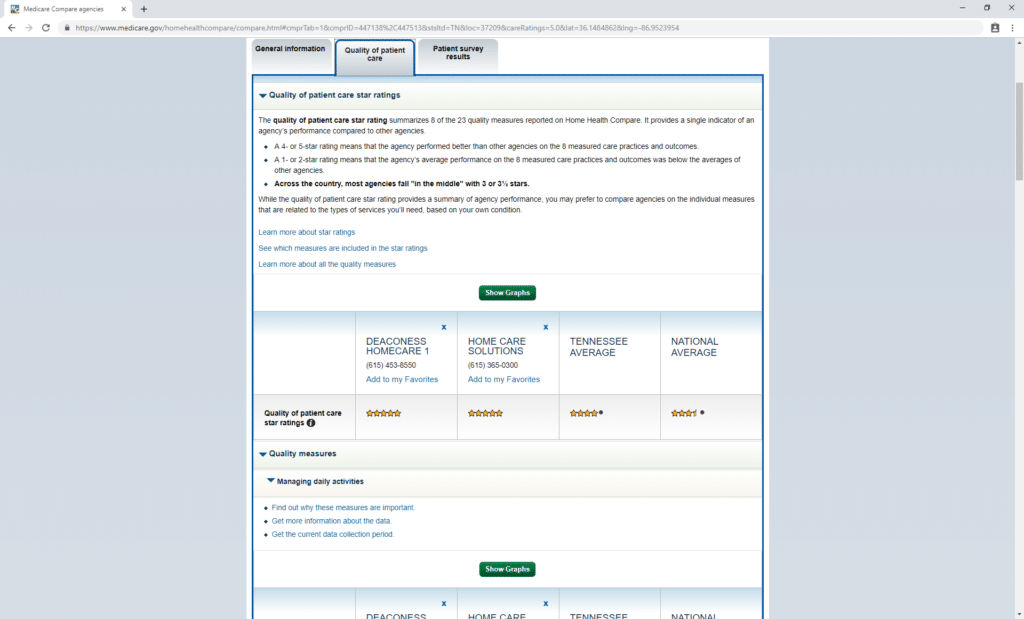
Once you’ve narrowed your choices down, you may want to inquire about an agency’s quality of care. Any home care agency who services Medicare clients and has serviced at least 20 patients will have a star rating.
Patient Care Star Ratings are based on patient health improvement and the outcome of home treatments and care.
How to Use Medicare’s Home Health Agency Finder
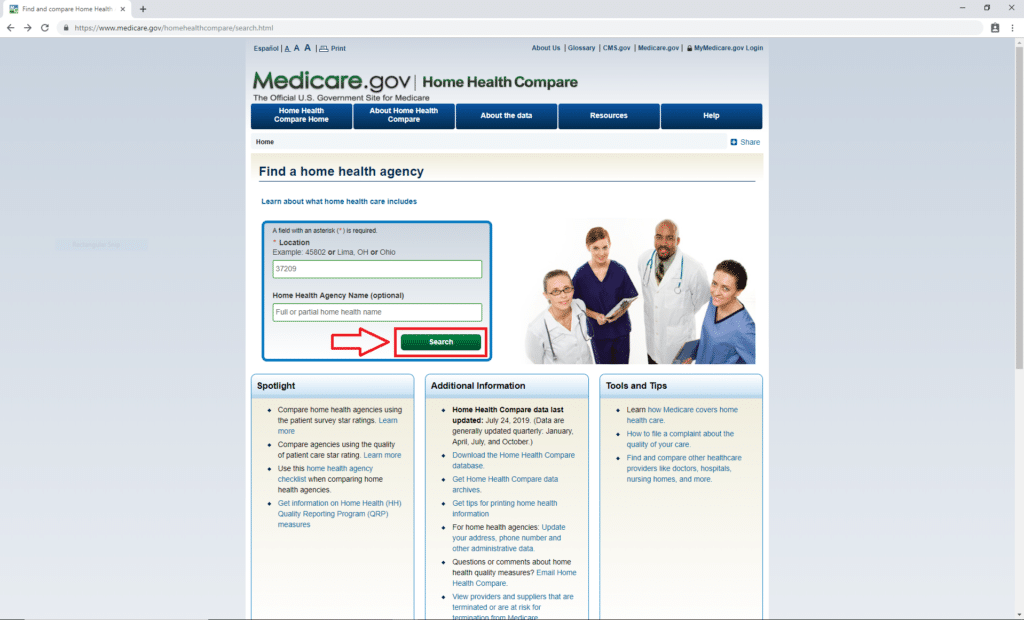
Click here to go to the Medicare Home Health Agency finder. Enter your zip code to search for home health agencies in your area and click “search.” We used 37209, which is the zip code for our corporate offices in Nashville, Tennessee.
Medicare Home Health Agency Finder Step 1 | Medicare Plan Finder
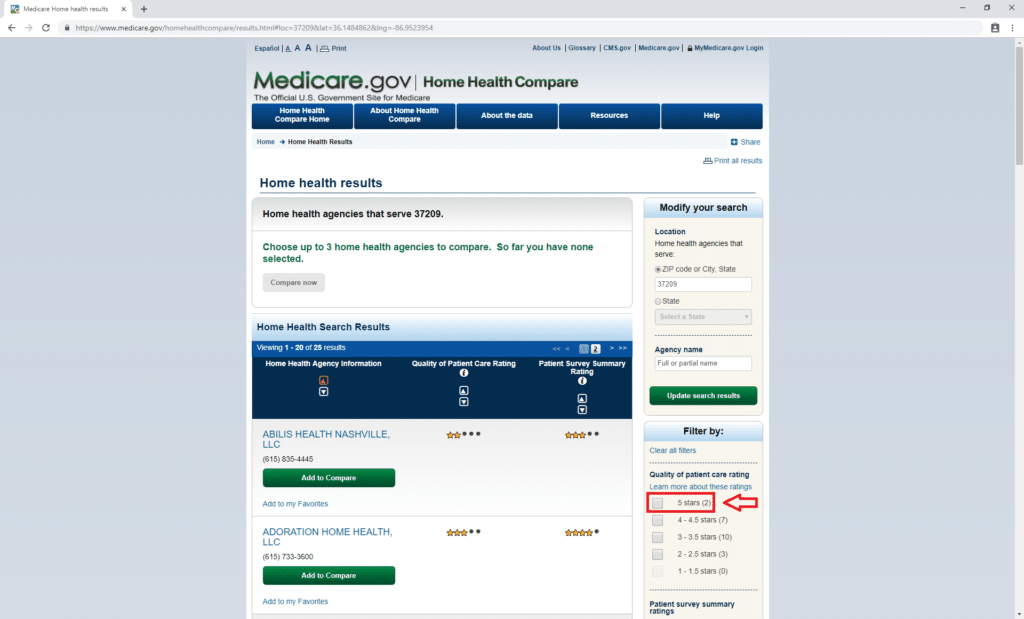
From there, you can filter search results by Medicare’s star rating and patient survey results. For demonstration purposes, we are only going to choose facilities with 5-star ratings.
Medicare Home Health Agency Finder Step 2 | Medicare Plan Finder
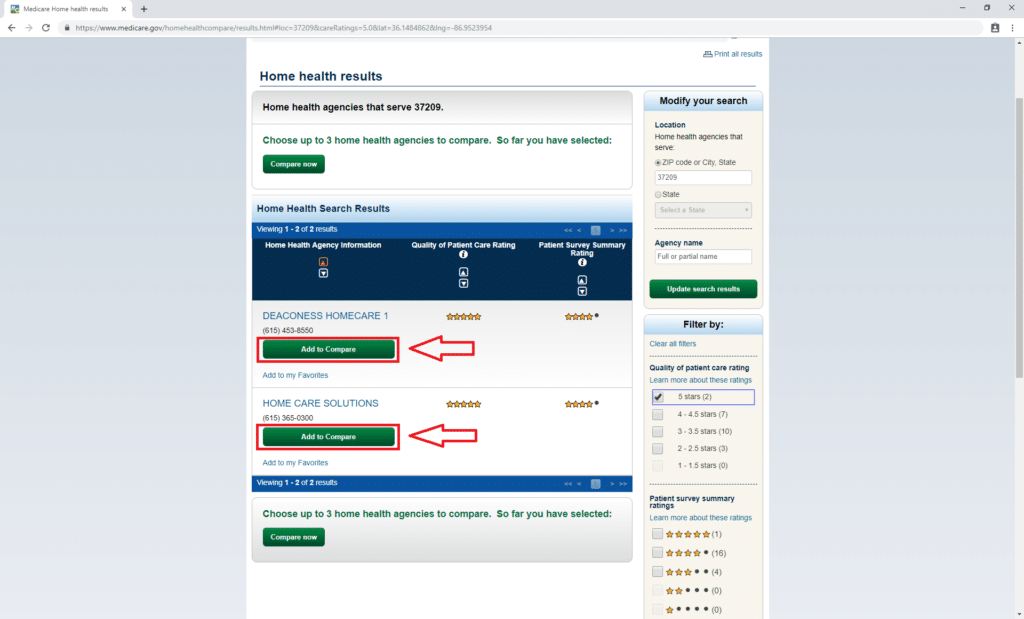
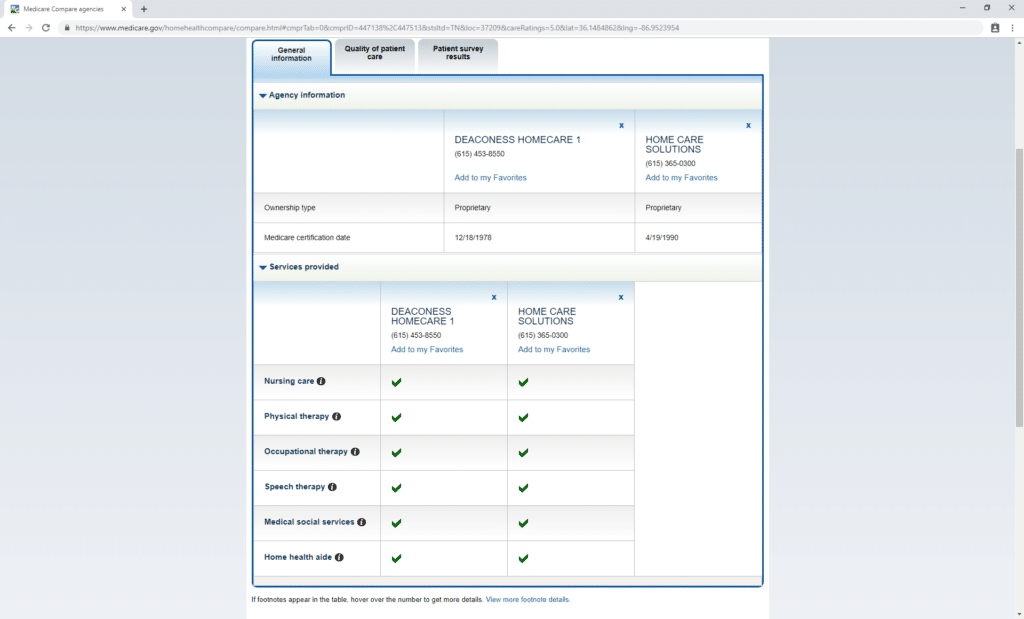
Once the agency finder returns your search results, click on the agencies you want to compare. In our case, the finder returned two results. In this instance, both Deaconess Homecare and Homecare Solutions are part of LHC Group Health Care, which has locations in 38 states. The agency’s proximity to your home may be a determining factor in your choice for home care.
Medicare Home Health Agency Finder Step 3 | Medicare Plan Finder
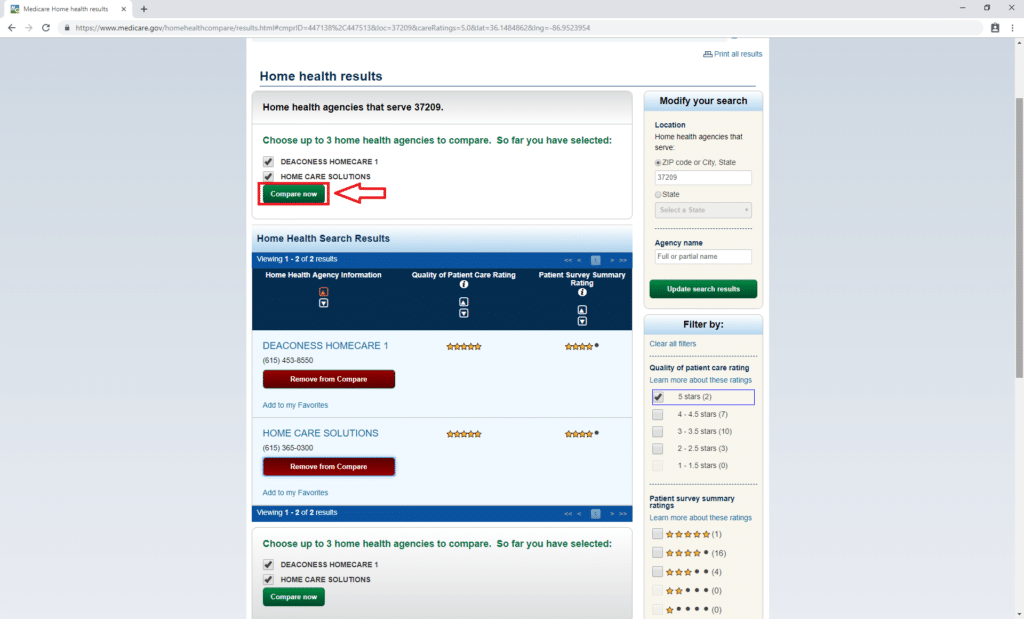
Then click “compare now.”
Medicare Home Health Agency Finder Step 4 | Medicare Plan Finder
Then the agency finder will show you comparison charts with general information, quality of patient care, and patient survey results. Use the comparison charts to help you make a decision about which home health agencies you want to contact.
Medicare Home Health Agency Finder Step 5 | Medicare Plan Finder Medicare Home Health Agency Finder Step 6 | Medicare Plan Finder Medicare Home Health Agency Finder Step 7 | Medicare Plan Finder
How Do I Qualify for Home Benefits?
To qualify for home benefits, a doctor will need to certify that you have a medical need. For example, your policy will not pay for your stair lift if you still can walk up the stairs on your own without too much difficulty.
As another example, if you only need a nurse to help you with something occasional, like blood transfusions, your policy will not pay for you to have a full-time live-in nurse.
Your doctor will have to meet you in person to determine that you are homebound and need skilled nursing care. After your initial certification, your doctor must recertify your home health care plan once every two months. A Medicare-certified home health agency (HHA) must provide the care.
When You Should Buy
Like other health insurance policies, you should buy a long-term care policy before you need it. Pre-existing conditions and your age can raise your premiums. If you buy while you’re still healthy, you’ll likely have lower costs. However, if you can’t afford the premium now, while you’re healthy, then it may be best to wait.
One of our licensed and experienced agents can help you figure out if a long-term policy is something you should buy now or wait for. If you think it’s time to buy now, we’ll help you find a great plan in your area.
This post was originally published on December 07, 2017, by Anastasia Iliou, and was updated on August 07, 2019, by Troy Frink.
How Medicare and Medicaid Work Together
Medicaid helps lower the cost of Medicare for more than 12 million dual-eligibles. In fact, Medicaid is the nation’s largest public health insurance program for people with low income and covers more than 1 in 5 Medicare enrollees. Are you eligible? Here is everything you need to know about Medicaid, Medicare, eligibility, costs, and savings programs.
What is the difference between Medicare and Medicaid?
Medicare and Medicaid can be easily confused, but they are two separate government-operated programs. Medicare is a federal program that provides health coverage for seniors over 65 and other Medicare-eligibles, regardless of your income. Medicaid is a state and federal program that provides health coverage for those with low income. However, if you are dual-eligible, you are eligible for both Medicare and Medicaid. This allows you to expand your network to include Medicaid doctors and decrease your out-of-pocket healthcare costs.
Those who are over 65 and those who receive SSDI (Social Security Disability Insurance) are eligible for Medicare.
Medicaid eligibility is different in every state and is largely based on income level. Though this varies by state and marital status, if you know that you are under the Federal Poverty Level, there’s a good chance that you qualify for Medicaid.
Can you Have Medicare and Medicaid?
If you are dual-eligible, that means you’re eligible for both Medicare and Medicaid. That can mean that you are both low-income and over 65, both low-income and on dialysis for ESRD, or any other qualifier listed below.
When you have both Medicare and Medicaid, Medicare will cover you first. Your Medicaid will serve as sort of a backup plan when you need more coverage than Medicare can provide.
People who are eligible for both Medicare and Medicaid may qualify for a Dual-Eligible Special Needs Plan, or DSNP. DSNPs often come with very low or $0 premiums, and Medicaid often covers the resounding copayments. DSNPs are not available in every area, and each plan can be a bit different, so be sure to ask your agent.
Dual-eligible beneficiaries are sometimes eligible for a Medicare Savings Program (MSP) as well. An MSP can help you pay for your Medicare premiums. You’ll also be enrolled in Extra Help, a program that helps you pay for your Medicare prescription drug costs. You may hear Extra Help referred to as LIS, or Low-Income Subsidies.
Bonus: if you are eligible for both Medicare and Medicaid, you have a Special Enrollment Period (SEP). That means that you don’t have to wait for the Annual Enrollment Period (AEP) to enroll or make changes to your plan.
Get the care you need from Medicare and Medicaid
Medicare and Medicare Eligibility Check
Ready to find out if you are eligible for Medicare? Do you fall into any of the below categories?
I am over the age of 65 or will be turning 65 within the next few months.
I have ESRD (End-Stage Renal Disease/Kidney Failure) and am receiving dialysis treatment.
I have Lou Gehrig’s disease (amyotrophic lateral sclerosis or ALS).
I have received Social Security Disability Income for over 24 months.
I receive retirement/disability income from the Railroad Retirement Board.
Note that to qualify, you also must be a U.S. citizen.
Medicaid eligibility is going to depend largely on what state you live in. While Medicare is more federally regulated, Medicaid is mainly state-regulated. For example (2018), in Tennessee, a family of four can qualify for Medicaid with an income of less than $32,718 annually. However, in New York, a family of four can only qualify for Medicaid with an income of less than $32,319.
Some of the groups that most commonly pass the Medicaid eligibility check are U.S. citizens like:
Those under 21 with low income
Pregnant women with low income
Low-income parents of minors
Low-income women undergoing breast or cervical cancer treatments
Those who receive Social Security benefits
Individuals who live in nursing homes or receive other long-term care and require financial assistance
If you think you are eligible, you can access the Medicaid Application for every state from the Healthcare Marketplace website.
Medicaid Doctors and Costs
A great way to find providers in your area who accept Medicaid is by using an online search tool like “DocSpot.” From DocSpot, you’ll enter your city, your type of coverage (Medicaid), and the type of doctor you are looking for. DocSpot will populate results for you where you can read reviews and pick Medicaid doctors in your area that you can schedule an appointment with.
If you have both Medicare and Medicaid, you can expand your doctor network to also include those who accept Medicare. If you have Medicare Advantage (a Medicare plan offered by private companies instead of the federal government), you’ll want to use your plan’s website to search for a provider that accepts your coverage.
Your Medicaid, Medicare, and Medicare Advantage costs will all depend on your financial status and the type of plan you select.
Medicaid Prescription Drug Costs
Technically, prescription drug coverage is an optional federal Medicaid benefit. Since Medicaid is a state-based program, all states determine their own prescription drug coverage. Currently, all U.S. states provide outpatient prescription drug coverage to eligible Medicaid beneficiaries. Depending on your state, you will receive either free or heavily discounted prescription drugs when receiving Medicaid benefits.
Free Prescription Discount Card
Additional Medicaid Costs
Some Medicaid beneficiaries will be required to pay copayments for certain services. It all depends on your income. For example, for non-institutional care (such as a doctor’s office visit), anyone at 100% of the federal poverty level will have to pay a copay of $4.00. Anyone whose income is 150% above the federal poverty level will have to pay 20% of the costs. Keep in mind that the federal poverty level can change every year and also takes into account the number of people living in your household.
Medicare Extra Help Application
If you have Medicare but do not qualify for Medicaid, fear not! You may still qualify for financial assistance in another form: Medicare Extra Help.
Medicare Extra Help, otherwise known as LIS (Low-Income Subsidies), helps you cover your prescription drug costs that Medicare does not cover. To qualify for Extra Help, you must first have Original Medicare (Part A and Part B). You cannot have savings, investments, and real estate that total more than $28,150 (or $14,100 if you are single).*
Medicare Savings Program Application
Even if you do not qualify for full Medicaid benefits or if you don’t qualify for Medicare Extra Help, you can still qualify for a Medicare Savings Program. There are four Medicare Savings Programs:
Qualified Medicare Beneficiary (QMB)
Pays for Medicare Part A and B premiums, deductibles, coinsurance, and copayments. Also makes you eligible for Medicare Extra Help. To qualify for QMB, you:
Cannot exceed individual monthly income limit of $1,032
Cannot exceed married monthly income limit of $1,392
Cannot exceed individual assets limit of $7,560
Cannot exceed married assets limit of $11,340
Specified Low-Income Beneficiary (SLMB)
Pays for Medicare Part B premiums. Also makes you eligible for Medicare Extra Help. To qualify for SLMB, you:
Cannot exceed individual monthly income limit of $1,234
Cannot exceed married monthly income limit of $1,666
Cannot exceed individual assets limit of $7,560
Cannot exceed married assets limit of $11,340
Qualifying Individual (QI)
Pays for Medicare Part B premiums. Also makes you eligible for Medicare Extra Help. To qualify for QI, you cannot have Medicaid and you:
Cannot exceed individual monthly income limit of $1,386
Cannot exceed married monthly income limit of $1,872
Cannot exceed individual assets limit of $7,560
Cannot exceed married assets limit of $11,340
Qualified Disabled & Working Individuals (QDWI)
Pays for the Medicare Part A premium if you are working, disabled, and under 65 OR if you lost your premium-free Part A when you went back to work. You must not be receiving state medical assistance. You also:
Cannot exceed individual monthly income limit of $4,132
Cannot exceed married monthly income limit of $5,572
Think you are eligible for Medicaid? You can apply either online through the Health Insurance Marketplace or through your state Medicaid agency. To use the Health Insurance Marketplace Medicaid Application, click here.
Each state has its own Medicaid Application on its own Medicaid website. It may be a good idea to meet with an agent first so that you can get help with your application.
Complete your Medicaid application
Are you eligible for Medicare and Medicaid?
If you’re not sure whether or not you are eligible for Medicare and Medicaid, we can help. Give us a call and we’ll ask you a series of questions to help you find out if you’re eligible.
If you are eligible, we can send an agent to your home to help you sort through your health care options. Another perk of being eligible for both Medicare and Medicaid is that you can receive a Special Enrollment Period, meaning that you can make changes to your coverage during any time of the year and don’t have to wait for the Annual Enrollment Period in the fall.
Our agents are licensed to sell plans from multiple different carriers, so they can help you pick the plan that truly works best for you.
To get started, give us a call at (833)-567-3163 or click here.
This post was originally published on March 15, 2018, and was updated on September 28, 2018, and updated again on April 3, 2019.
Special Enrollment Period Medicare
Most people are only eligible to enroll in Medicare during their Initial Enrollment Period (three months before and after your 65th birthday) or during the Annual Enrollment Period (October 15 – December 7). However, there are several circumstances that may allow you to enroll in a Special Enrollment Period Medicare plan, including Part B, Medicare Advantage, Medicare Supplements, or Part D, outside of the initial and annual enrollment periods!
If you qualify for a SEP, you should take advantage of your ability to get yourself into a better plan. This includes:
Switching to a new plan in your area
Moving from one Medicare Advantage plan to another
Enrolling in Medicare Advantage for the first time
Switching from a Medicare Supplement plan to Medicare Advantage
Adding or changing prescription drug coverage
Different Types of SEPs
There are two main types of SEPs – lifelong and circumstantial. Lifelong SEP means you qualify for a SEP every year, unless your eligibility changes. For example, if you were eligible for Medicaid, but your income increased drastically, you may no longer be eligible. Circumstantial SEP means you qualify for a special enrollment period one time, depending on your circumstances. For example, if you move to a new service area, you will be able to make changes one time, unless you qualify for a different reason at a later date.
Another way you can qualify for a SEP is through a 5 star Medicare plan. If you are not currently enrolled in a 5 star Medicare plan, but one becomes available in your area, you can enroll in a better plan without being penalized. To learn more, click here.
Lifelong SEP
To qualify for a lifelong SEP, you must fall into at least one of the following categories:
Be eligible for Medicaid or a Medicare Savings Program
Part of SPAP (State Pharmaceutical Assistance Program)
Many people who qualify for a lifelong SEP are eligible for a Special Needs Plan. You must live in an area that supports a SNP plan as they are not available everywhere. Then, to be eligible, you must have a special need. In the case of SNPs, special needs can mean Medicaid-eligible/low-income (D-SNP), institutionalized (I-SNP), or diagnosed with a severe or disabling chronic condition (C-SNP).
Circumstantial SEP
To qualify for a circumstantial SEP, you must:
Move to a new service area
Involuntarily lose your coverage (for example, if your plan stops accepting Medicare assignment)
Find a contract violation with your plan
Lose or gain a job with group health insurance
Move into or out of a facility
Leave imprisonment
Enter or leave a health facility
Gain or lose Medicaid eligibility
Gain or lose Medicare Savings Program or LIS eligibility
Have been automatically enrolled in Part D
Special Enrollment Period Medicare Part B
In some cases, you may have a Special Enrollment Period for Medicare Part B (and Part A). If you are covered by a group health plan from your employer (and you are still employed), you may be granted a Special Enrollment Period. This SEP will begin the month after your group health plan or your employment ends and will generally last for eight months.
In most cases, this means that even though you are passing your Initial Enrollment Period, you will not face a late enrollment penalty fee (due to your employer coverage still being active).
How long does the special enrollment period last?
Special enrollment periods typically last 60 days. This means you have roughly two months to change or enroll in a different plan. However, depending on your circumstances, you may be limited to the changes you can make and the time frame could differ. Your best bet is to speak with a licensed agent and discuss eligibility and plan options. To ask any questions or to speak with a licensed agent, fill out this form.
Is being eligible for Medicare a qualifying event?
Being eligible for Medicare is not a qualifying event for a special enrollment period. If you are about to turn 65, you are eligible to enroll through your initial enrollment period, not a special enrollment period. The only events that qualify you for a SEP are listed above. If you have any questions on if your situation applies, fill out this form, and we will be in touch with you.
Do I qualify for a Special Enrollment Period Medicare Plan?
We get it, enrollment periods can be confusing, and it can be difficult to know if you qualify. If you aren’t sure whether or not you qualify for a special enrollment period medicare plan, or which enrollment period you need to use to enroll, we can help you. We can also help you figure out if you are eligible for a SNP Medicare Advantage plan, LIS (otherwise known as Extra Help) or another health care savings program, which will allow you to change plans at any time. To set up a free appointment with a licensed agent in your area, call 844-431-1832. As always there is no cost to you and no obligation to enroll.
This blog was originally published on 4/17/17, but was updated on 3/29/19.
What are Medicare MSA Plans (Medicare Medical Savings Accounts)
A Medicare Medical Savings Account, or MSA, is one of six different types of Medicare Advantage plans. Medicare Advantage plans are private Medicare plans that cover everything Original Medicare covers but can add in additional benefits like dental, vision, hearing, physical fitness, non-emergency medical transportation, and more. The MSA plan type creates a non-taxable financial account for your healthcare costs.
How do Medicare MSA Plans Work?
If you’ve previously had a healthcare plan through an employer or the individual marketplace, you may have heard of an HSA, or Health Savings Account. Medicare MSA plans are similar to HSA plans. The plan you choose will include a bank account with a set amount of money in it. You can use that money to pay for your healthcare costs. If you use all of the money in your account and need more, don’t worry: once you meet your plan’s deductible (a set limit on what you can spend), you will be fully covered. If you don’t use all of the money in your MSA, it will carry over to the following year. This way, you can continue to build on your account. The money in your MSA is not taxable.
MSAs are also different from other Medicare Advantage plan types, like HMO (Health Maintenance Organizations) and PPOs (Preferred Provider Organization) in that you do not have to select a primary physician. Depending on your plan, you may still have a network, but it wouldn’t be nearly as strict as another plan model.
The Cost of an MSA
You will not have to pay a monthly premium specifically for your Medical Savings Account, but you will have to pay a premium if your plan includes additional Medicare Advantage benefits. Regardless, you will still pay your Part B premium.
Your plan determines the amount of money that goes into your account each year – this depends on the plan you choose. Once that is settled, you cannot go in and deposit additional monies. You will have a card that functions somewhat like a debit card for your medical expenses. When you use the card, the money will be taken from your account and given to the doctor. You will receive a statement each month that tells you what money has been taken out of your account and for what purpose. You can ONLY use this card for medical expenses. If you use the card for non-medical expenses, you will then have to pay a 50% tax penalty.
What do Medicare Advantage MSA Plans Cover?
Medicare MSA plans and other types of Medicare Advantage plans start by covering everything that Medicare Part A and Medicare Part B cover. Then, individual Medicare Advantage MSA plans often add benefits like dental, vision, long-term care, additional home health, and more. MSAs are different from other types of Medicare Advantage plans in that they typically do not cover prescription drugs.
In 2017, the Kaiser Family Foundation released data that only 3% of people enrolled in a Medicare Advantage plan selected an MSA option. The MSA plan type is typically better for those who are healthy, not taking expensive prescriptions, and more worried about cost savings than additional benefits.
Medicare Medical Savings Account Eligibility
Most people who are eligible for Medicare can enroll in a Medicare Advantage MSA plan. There are a few exceptions:
Those who have another form of health insurance coverage (employer or group coverage, individual health plan, TRICARE, etc.)
Anyone eligible for Medicaid
Those with ESRD (End-Stage Renal Disease) and those who are in hospice
Non-citizens and those who live outside of the United States for more than half of the year.
If you aren’t sure whether or not you can enroll in an MSA, or if you would like to talk to a professional about your various plan options, send us a message now or give us a call at 844-431-1832.
What is a Medicare PPO (Preferred Provider Organization)?
A Medicare PPO, or Medicare Preferred Provider Organization, is a type of Medicare Advantage plan. It’s different from other Medicare Advantage plans because while you will select one Medicare preferred provider (doctor), you will have the freedom to use other doctors. Your costs will be cheaper if you use doctors, hospitals, and specialists that are within your PPO network, but you do have the freedom to see several different doctors.
What is Medicare Advantage (MA)?
Medicare Advantage plans are owned and operated by private companies instead of the federal government. This means that though they cover everything that Original Medicare covers, they are allowed to add additional benefits like dental, vision, non-emergency transportation, and even physical fitness.
MA is great for people who are looking for ways to save money on healthcare and have coverage for specialty healthcare services.
Medicare PPO plans are just one type of Medicare Advantage. They are called Medicare “Preferred Provider Organization” plans because even though you will select one provider that is “preferred,” you do have the freedom to see other doctors. This is a huge “pro,” especially for people who see multiple specialists for different healthcare concerns.
It is also a convenient option for people who are not comfortable with the idea of having a strict plan network. If you want to get a second opinion on a health concern, or if you decide you want to switch doctors, it will be easier to do so with a PPO than if you had an HMO plan model.
The downside to having a PPO plan is that PPO options are typically more expensive than other plan types. PPOs usually have higher co-payments; this is the cost of flexibility. A Medicare PPO will usually have a co-payment averaging between $10 and $15 per office visit.
Medicare HMO vs PPO
As mentioned, HMO (Health Maintenance Organization) plans are generally cheaper than PPOs. They are different because HMOs require you to select one primary physician that you visit for all of your healthcare needs; you won’t be able to visit another doctor without a referral.
In most cases, HMOs do not require co-payments when you visit your primary physician. Ultimately, your HMO vs PPO decision will come down to whether costs or flexibility are more important to you.
There are very few eligibility limits for Medicare PPO plans. As long as you are eligible for Medicare and reside in an area where a Medicare Advantage PPO plan is available, you probably qualify.
This means that you can qualify for a PPO if you are age 65 or older, have ALS (Lou Gehrig’s Disease), or have been receiving SSDI (Social Security Disability Insurance) for at least 25 months. The only exception to this is for some people who have ESRD (End-Stage Renal Disease). ESRD is the only pre-existing condition that Medicare Advantage PPO plans do not typically cover.
Most PPO plans will charge a monthly premium (in addition to your Part B premium). Costs will vary significantly based on the amount of coverage your plan includes.
For example, a plan that includes prescription drug coverage will have a much higher premium than a plan that does not. You will then have co-payments for most medical services which can range from as little as $10 for a doctors appointment or prescription and up to hundreds for hospital services and procedures. However, there are usually limits on how much you will be asked to pay out of pocket with your PPO plan. This can easily range from $1,000 per year to $4,000 per year or more. Once you hit your out-of-pocket limit, you will be fully covered.
Medicare Advantage PPO Plans Near You
Ready to find a Medicare Advantage PPO (or HMO) plan available in your area? Plans vary by county, city, and even zip code. We can help you look at the options available in your area. To get started, send us a message or give us a call at 844-431-1832.
Take Advantage of Medicare Wellness Exams and Preventative Benefits
Medicare offers many benefits at zero cost to recipients, but many of the 59 million Americans enrolled are either not aware of all the Medicare wellness benefits or are simply not taking full advantage of all of these offered services.
For example, in 2014 only around 14% of Medicare recipients received the freeMedicarewellness exam covered under Medicare Part B. This exam, known as the Annual Wellness Visit, or sometimes known as the acronym AWV, is covered at zero cost to recipients.
What is Included in Medicare Wellness Exams?
Once you’ve had Medicare Part B for at least 12 months, you are eligible for a zero cost yearly* Medicare wellness exam. The purpose of this wellness visit is to work with your doctor to identify any risk factors to watch, as well as to develop a plan for staying healthy.
*Keep in mind that the AWV is available every twelve months. For example, if your first AWV is June 2, you cannot recieve your next one until June 2 of the following year. If you make your appointment for June 1, you may not be covered.
During the wellness visit, your doctor, nurse practitioner, or another health care professional will review things like your health history, take measurements such as weight and body mass index (BMI), and will help develop a preventative care plan tailored for you.
Some items that may be reviewed during your Medicare Wellness Visit include:
A Health Risk Assessment (HRA) questionnaire
Review of personal medical history and family medical history
Measurements including height, weight, BMI, and blood pressure
Assessment for any cognitive impairment and mood disorders
Review of any difficulty you may be having in performing day-to-day tasks
Your health care provider may also help you establish a plan for potential risk areas including fall prevention, nutrition, weight loss, and tobacco cessation.
What is not Included in your Medicare Annual Wellness Visit (AWV)?
It is important to know that the Medicare Annual Wellness Visit covers a specific set of wellness services and is different than an annual physical, which is not covered by Medicare. It is also important to note that any additional services performed during your Medicare exam may result in an additional copay or deductible cost.
For example, Mary is 68 years old and visits her doctor a few days after her birthday, as she does every year for her free Medicare wellness exam. During the visit, Mary mentions that her right foot has been bothering her, and after further examination, her doctor orders a blood test to check for gout.
In this scenario, Mary’s wellness visit is still free, but she may pay a copay for the additional foot examination as well as the blood test.
Medicare Wellness Exam vs. Annual Physical
The annual wellness visit is not the same as the yearly physical you may be familiar with. For a typical physical, your healthcare provider will perform a hands-on, head to toes exam including lung, abdominal, and neurological exams. Medicare exams are different.
The Medicare annual wellness visit includes similar assessments but does not include any exams that require the healthcare provider to physically examine you. During your wellness visit, your provider may schedule additional preventative screenings, or may further examine any issues you are having.
What to Bring to Your Medicare Annual Wellness Visit
One of the main purposes of the annual wellness exam is to identify any potential health risks and develop a plan to manage them. So, you will want to share your family and personal health history with your provider in as much detail as possible.
Some things to bring include:
Medical and immunization/vaccination records
Detailed personal and family health history
Detailed list of medications and supplements including dosage and frequency
Full list of health care providers you are currently seeing
Other Medicare Wellness Benefits
In addition to the annual wellness exam, there are a number of additional services, screenings, and vaccinations covered at no cost including:
Alcohol screening
Bone mass measurements
Cardio screening
Colorectal screening
Diabetes screening
Hepatitis screening
HIV screening
Lung, prostate, and cervical cancer screenings
Medicare Vaccine Coverage and the Medicare Flu Shot
Medicare Part B also covers some other Medicare wellness benefits like preventative vaccines, including yearly flu shots. Ask your doctor about getting your flu shot during your Medicare exam.
However, Medicare does not provide maintenance coverage for other vaccines including Shingles, Tetanus (Tdap), and Meningococcal. These vaccines and additional immunizations are typically covered under Part D prescription drug plans.
To ensure you are covered for these vaccines and other prescription medication, you can add a Part D plan to Medicare Parts A and B, or choose a Medicare Advantage plan that includes Part D coverage.
Other Ways to Make the Most of Your Medicare Plan
Find Doctors in Your Plan Network
Some carriers have doctor and hospital search engines so you can see which doctors are covered under your plan. ZocDoc is a great non-affiliated doctor search website as well. If you continue to use a doctor that is outside of your plan, you’re wasting potential savings that you’ll receive if you visit a doctor who is within your plan’s network.
Use Generic Drugs
The same goes for pharmacies and drugs. Your coverage is likely much higher for generic brand prescription drugs, so ask your doctor for a generic version when he gives you a prescription. Your coverage includes mail-order prescriptions as well. Mail-order is often cheaper because there are fewer labor costs! Plus, you can buy bigger supplies.
Know Your Additional Benefits
Some Medicare plans include discounts and freebies like gym memberships, massages, nutrition classes, support groups, and even LASIK surgery. Some even provide “rewards” in the form of discounts if you stay healthy.
Get More Benefits with Medicare Advantage
There are many Medicare preventative services that Original Medicare covers, but do you need more?
A Medicare Advantage plan is a private Medicare plan that includes your Part A and Part B benefits and can extend your coverage to include more things like:
A Medicare Advantage Plan and Part D prescription drug coverage can help cover you for these additional costs and help you live the healthiest life possible. Our agents can help you understand all of your plan options and enroll you in a plan that fits your specific needs and budget. If you interested in arranging a no-cost, no-obligation appointment, fill out this form or call at us 844-431-1832.
Understanding Your Best Cancer Insurance, Heart Attack Insurance, and Stroke Insurance Options
Medicare is designed to provide coverage for the most basic healthcare that everybody needs. Therefore, it does not include extensive cancer, heart attack, or stroke coverage. That’s why many Medicare beneficiaries enroll in secondary health insurance plans to supplement their current coverage gaps.
Original Medicare Part A covers hospital costs, and Original Medicare Part B covers doctor visits. Medicare Advantage adds on prescription drug coverage as well as other benefits like fitness incentives, dental, vision, and hearing.
Medicare Supplement plans add on extra coverage for your deductibles, copayments, and coinsurance (and sometimes cover prescriptions as well). While those Medicare options are certainly useful for both your wallet and your health, they simply won’t cover all of your health care needs. That’s where ancillary plans, (also known as secondary health insurance plans) come in.
Do you Need Supplemental Insurance?
Supplemental insurance plans provide coverage for medical procedures and needs that Medicare won’t. You might wonder, “why doesn’t Medicare just cover everything in one plan?” Well, Medicare is a government program, and everyone’s healthcare needs are different. It is not lucrative for Medicare to cover everything. That’s why people who need extra financial help can add on ancillary coverage to help cover their extra healthcare costs.
If you have a medical history that includes cancer, heart disease, or stroke symptoms, you may benefit from an ancillary plan that specifically covers your symptoms or can give you extra cash. That’s why you should always disclose all your healthcare and financial information to your agent – they can’t help you get the right amount of coverage if they don’t know how much coverage you need!
Most ancillary plans work by sending reimbursement checks (usually upon diagnosis). You’ll tell your plan when you are diagnosed with a disease, and they will send you a check based on your policy value (sometimes all at once, sometimes annually, etc.). Since your money will come in the form of a reimbursement, you can technically use it for whatever you need – loss of income, childcare, travel to facilities, home health care, rehabilitation/therapy, and any other out-of-pocket costs that Medicare does not touch.
What Does Cancer Insurance Cover?
Cancer insurance plans can vary greatly. In general, you’ll find policies that cover services like:
Blood and plasma
Breast reconstruction
Chemotherapy
Child/pet care expenses
Extended care facility stays
Hospice
Hospitalization
Initial diagnosis
Medical imaging
Organ transplants
Prosthetics
Radiation
Rehabilitative therapy
Surgery
Transportation and lodging related to hospital stays
What are the Best Cancer Insurance Plans?
No other disease statistics come close to cancer. Men have about a 50% chance of developing cancer, while women have about a 33.3% chance. Cancer kills about 1,600 Americans every day and includes about 10% of American healthcare expenses.
There really isn’t one best cancer insurance policy, because everyone’s financial and healthcare needs are different. However, one of the “best” and most common options is a lump sum policy. For a monthly payment of even as little as $20 per month, you can invest in a policy worth anywhere from a couple thousand to a hundred thousand dollars. If you are then diagnosed with cancer, you will receive the lump sum of your policy’s cash value to help you cover your cancer costs.
Lump sum cancer insurance is a good idea if you have a family history of cancer or if you meet any risk factors, such as a history of tobacco use, increased sun exposure, or obesity. If you already have a cancer diagnosis, you may not be able to enroll in this type of cancer insurance. A Medicare Advantage or Medicare Supplement plan might be a better option, as pre-existing conditions will not prevent you from enrolling. Plus, you can choose a Medicare Advantage plan or Medicare Supplement plan with great prescription drug benefits.
Cancer Insurance Pros and Cons
Cancer Insurance Pros:
Financial Relief – While you’re worrying about your health, you don’t want to have to worry about your finances. Not only is cancer treatment expensive, but you may have to leave your job to adequately receive the treatment you need! Not only can cancer policies help you pay for your care, but they can also help you recover from lost income.
Extra Medical Coverage – Original Medicare covers basic hospital and doctor costs, and you might have a prescription drug plan, but Medicare alone does not cover all cancer-related costs. A cancer plan will help you pay for extra prescriptions and procedures.
Peace-of-Mind – If you have a family history of cancer or if you’ve shown signs, having a cancer policy can give you the peace-of-mind to know that you’re covered in the event of a diagnosis.
Cancer Insurance Cons:
Availability – Cancer insurance can be harder to find than other health insurance options. However, our licensed agents are able to sell plans from most cancer insurers in your area. A MedicarePlanFinder agent can help you find what you need.
Pre-existing Conditions – If you’ve had any cancer symptoms in the past, it may be hard for you to find a cancer policy. It is really designed for those who have a family history of cancer and want to make a smart decision early on. That’s why you should buy now, BEFORE your diagnosis.
Types of Cancer Insurance
Lump Sum Cancer Insurance
A lump sum cancer insurance plan is meant to provide extra cash when you need it most: while you’re undergoing treatment. You will receive a payment for the value of your policy (usually between $5,000 and $100,000), at the time of your diagnosis.
Indemnity Cancer Plans
Indemnity plans are designed to help you pay for the costs of staying in a hospital for an extended period of time. Instead of paying out your benefits all at once in a lump sum, an indemnity cancer plan can pay you per day. For example, it might pay out $300 for each day you spend in the hospital.
Top Cancer Insurance Plans
While there are seemingly endless possibilities for getting cancer coverage, these are some of the top cancer insurance plans that Medicare Plan Finder agents currently offer (subject to change):
Aetna Cancer Insurance
Aetna offers a cancer, heart attack, and stroke insurance policy for seniors and Medicare eligibles. You or a person that you designate will receive a lump sum based on your policy value upon your cancer diagnosis. The policy can be valued at anywhere from $5,000 to $75,000.
Aetna cancer policies give you a 30-day “look” period. That means that if you decide within 30 days of your purchase that you do not like the plan you chose, you can back out.
Cigna Cancer Insurance
Cigna’s cancer policies can cost you as little as $19 per month and can cover you for as little as $5,000 or as much as $100,000. Cigna cancer coverage is available to anyone ages 18-99. For an added premium, you can also receive coverage for cancer recurrence, heart attacks, and strokes.
Mutual of Omaha Cancer Insurance
Mutual of Omaha offers both a cancer only insurance plan and a cancer, heart attack, and stroke insurance plan. Since the policy pays out as a lump sum at the time of diagnosis, you can use it however you want, regardless of who your doctors are.
GTL Cancer Insurance
Guarantee Trust Life (GTL) cancer insurance is wrapped into one policy including cancer, heart attack, and stroke coverage. They pay a lump-sum upon diagnosis regardless of what other health insurance you may have. GTL benefits are flexible but range up to $75,000.
Medico Cancer Insurance
Medico will pay a lump sum benefit upon your internal cancer or malignant melanoma diagnosis. It is a one-time benefit paid directly to you – you can use it in any way you see fit!
Frequently Asked Questions About Cancer Insurance
Can I get cancer insurance after diagnosis?
It can be a challenge to get a good cancer insurance policy after you’ve already been diagnosed. That’s why we recommend that you look at your cancer insurance options NOW, to avoid any financial surprises later.
Is Cancer Insurance Worth it?
In short, yes! Wouldn’t you rather pay a small fee every month now instead of paying thousands upon thousands later? Investing in your health now allows you to plan for the finer things in life, like a beautiful retirement!
Can I buy cancer insurance online?
We don’t recommend buying without speaking to a licensed agent. Medicare Plan Finder agents are licensed with multiple insurance carriers, which means they can help you find quotes for several different plans and help you choose the best one for your needs.
How much does cancer insurance cost?
This really is going to depend on what you need. All carriers offer different types of plans that offer different amounts of coverage. If you do not have a personal history of cancer, you can get $5,000 of coverage for about $16/month! Of course, the more coverage you want, the higher your monthly costs will be.
Who sells the cheapest cancer insurance?
Cigna offers one of the cheapest plans at as little as $19 per month, and Mutual of Omaha boasts of rates as low as $10 per month! Your choice will depend on your healthcare needs, how much coverage you want, and your geographic area. Remember, not all plans are available in every state or county. It’s more important to look at the coverage that you’re getting first, THEN consider the cost. Our agents can help you find the best balance.
What other types of coverage are included in cancer insurance?
Cancer, stroke, and heart attacks are three of the most common ailments in America. Some cancer insurance policies are wrapped into one policy that includes stroke and heart attack coverage. This means that if you develop a heart condition now and develop cancer symptoms later, your one cancer, heart attack, and stroke policy will likely cover all or most of your conditions.
What Does Stroke Insurance Cover?
According to stroke.org, a stroke occurs every 40 seconds and is the 5th leading cause of death in the United States. A stroke happens when blood flow is cut off from an area of the brain, resulting in brain cells losing oxygen and dying. The dying cells lead to memory and muscle control loss. Small strokes may only result in temporary weakness, while large strokes can permanently paralyze a person.
Shockingly, nearly 80% of strokes are preventable. You can help prevent strokes by keeping a healthy weight and blood pressure, exercising regularly, avoiding excess alcohol consumption, and not smoking.
When looking for stroke insurance, Medicare Advantage and Medicare Supplement plans are great places to start. Having extra Medicare coverage will most likely give you access to more affordable healthcare through your doctors and pharmacies.
If that is not enough coverage, you can invest in a stroke policy. Most stroke policies are combined with heart attack policies. Stroke insurance is usually paid out as a lump sum (ranging from as low as $5,000 to as much as $100,000), which means it can cover anything from relevant surgeries to income replacement, instead of covering individual benefits.
Heart Attack Insurance
The CDC states that about 610,000 Americans die of heart disease every year. As common as heart disease is, it’s not cheap to handle. It can cost upwards of $20,000 for a hospital stay alone, not including the costs of any surgeries and prescriptions that follow.
While your Medicare plan may cover your hospital stay costs, it may not completely cover the surgeries and prescriptions you need. In fact, Original Medicare does not cover prescriptions at all. You will need to enroll in either a separate prescription drug plan (otherwise known as Part D) or either a Medicare Advantage or Medicare Supplement plan that includes prescription drug coverage. That’s why a heart attack/stroke plan is a great option. After a heart attack, you can receive a lump sum based on your policy value to help you pay for care or replace lost income.
Cancer, Heart Attack, and Stroke Insurance
Some cancer, heart attack, and stroke insurance policies are looped into one policy. The same policy can cover heart transplants, physical therapy, patient and family member transportation and lodging, bypass surgeries, anesthesia, replacement of lost income, and help with home expenses.
Costs for cancer, heart attack, and stroke policies will vary based on your needs and how much coverage you want to pay for. If you prefer, you can pay as little as $20 per month (but will have less coverage than if you paid a higher monthly premium).
Help Us Help You
If your family medical history includes strokes or heart attacks, be sure to disclose that information to your Medicare agent. They can help you pick a plan that best encompasses your needs, and then help you decide whether or not you need to add an ancillary policy.
Do you have an agent? Our agents are able to sell countless different plans, so they can help you find the one that truly works best for you. Submit your contact information on Medicare Plan Finder so we can have one of our licensed agents reach out to you. If you’d prefer, give us a call today at 844-431-1832.
This post was originally published on March 23, 2017. It was updated on October 23, 2018, and again on July 18th, 2019.
Understanding The Benefits Of Medicare Advantage
Medicare Advantage is a coverage option that provides more benefits than basic plans. It includes Original Medicare, which is made of Medicare Part A (hospital care) and Part B (medical/doctor care), plus additional services such as prescription drug coverage, dental, and vision coverage.
Medicare Advantage plans are sometimes confused with Medicare Supplement (Med Supp) plans, but they are completely different. While Medicare Advantage (MA) includes extra service coverage, Medicare Supplement plans provide more financial coverage (but not more services).
Medicare Advantage Benefits
Hospital stays, skilled nursing care, home health care, etc. (essentially Part A)
Doctor visits, outpatient care, preventative services, etc. (essentially Part B)
Hearing care, vision care, fitness programs, wellness services, nurse help lines, prescription drug coverage, etc. (Part C)
Prescription drug coverage (essentially Part D)
Types of Medicare Advantage Plans
HMO Plans(Health Maintenance Organization) – You’ll select one primary physician and only see that doctor, unless your doctor recommends another specialist (such as a cardiologist or dentist).
HMO-POS Plans(Point-Of-Service) – You’ll select one primary physician but can also visit other specialists in your network for a fee (like a cardiologist or dentist) even without a doctor recommendation.
PPO Plans(Preferred Provider Organization) – You can see any doctor, but in-network doctors will be much cheaper for you.
PFFS Plans(Private Fee-For-Service) – You will not need referrals or a primary physician, but not all doctors will accept this plan.
SNP (Special Needs Plans) – You are only eligible if you have a chronic illness or disability, live in a nursing home, or are dual-eligible for Medicare and Medicaid.
MSA(Medical Savings Account) – Medicare will deposit money into a separate bank account for you to use for Medical expenses.
Enrollment Periods
There is a seven-month window during which you can enroll in Medicare. It lasts from three months before your 65th birthday through three months after. During this period, you can purchase a Medicare Advantage plan for the first time or add any additional coverage. Additionally, you can always add or change your plan during the annual enrollment period, or AEP (October 15th through December 7th every year).
You may qualify for a SEP (Special Election Period), during which you can enroll even though it is not during AEP or your initial enrollment period. You can qualify if you:
Move residences to an area where different plan options are available
Move to an area where the nearest hospital or doctor’s office is out-of-network
Are released from incarceration
Lose Medicaid eligibility
Leave a job or start a new job that offers different plans
Were in a plan that is now discontinued
Do you still have questions about Medicare Advantage or are you hoping to purchase a plan? Set up an appointment with one of our licensed agents today. Call us now at 1-844-431-1832.
Understanding Medicare Enrollment Periods
Did you know that most people can only enroll in Medicare during a few months out of the year? Read through to figure out what medicare enrollment periods you are eligible to enroll during. If you still need help, one of your licensed agents can answer your questions!
IEP (Initial Enrollment Period)
Most seniors and Medicare eligibles will begin with an IEP. Your IEP begins three months before your 65 birthday and ends three months after, for a total of a seven-month timeframe. Some seniors and Medicare eligibles will be automatically enrolled in Part A and Part B and will receive a Medicare card three months before their 65 birthday. Others will need to elect to enroll and will start to receive coverage within a few months.
If you have an IEP but choose not to enroll, you may be faced with a higher premium because you enrolled late. You will be able to complete your late enrollment during the General Enrollment Period.
(GEP) General Enrollment Period
The GEP is exclusively for those who are enrolling in Medicare for the first time and missed their IEP. It runs from January 1 through May 31 of each year for Original Medicare and April 1 through June 30 for prescription drug plans and Medicare Advantage. If you enroll during the GEP, your coverage will begin in July.
(AEP) Annual Enrollment Period
AEP starts on October 15 of each year and runs through December 7. This is when every Medicare beneficiary can change plans or enroll in new plans. It’s a good chance for you to look at your current coverage, compare it to your healthcare and financial needs, and make adjustments if necessary. If you wait too long, you’ll have to wait a whole year before you can make changes again.
(SEP) Special Enrollment Period
If you qualify for Medicaid, Social Security, or another financial assistance program, you may be eligible for a Special Enrollment Period. If you have an SEP, you do not have to wait until AEP to make changes to your Medicare. Some people will have a continuous SEP, meaning they can make changes at any time. Those who have special circumstances such as moving, losing a job, or moving into a facility will have a 60-day SEP.
Get Help Understanding Your Enrollment Period
Still not sure when you can enroll? That’s ok, it can be confusing. Call us at Medicare Plan Finder and we can help you figure out whether or not you can get into a better plan. Just click here to request a call or call us at 1-844-431-1832.