Does Medicare Pay for Assisted Living or Nursing Homes?
Aging can bring up concerns about long-term care for many people, especially if there’s nobody at home to help out. You may wonder about nursing homes or assisted living facilities and how you’ll pay for it when the time comes. If you have Medicare, you may want to know, “Does Medicare pay for assisted living or nursing homes?”
How Much Does Medicare Pay for Assisted Living or Nursing Homes?
Nursing home care can be extremely expensive. According to Genworth, a private room in a nursing home costs an average of $8,517 a month, and assisted living facilities cost an average of $4,051 a month.
Original Medicare –– the public health insurance created in 1965 for retirees –– helps pay for a variety of healthcare costs, but nursing home care itself is not one of them. Custodial care doesn’t fall under Medicare’s guidelines for medical coverage. However, Medicare can help pay for medical expenses during a nursing home stay.
Medicare Part A (hospital insurance) covers up to 100 days at a skilled nursing facility. According to the Medicare Rights Center, “Medicare will not cover the cost of your stay if you need additional days,” or if you need long-term care in an assisted living facility. Part A also covers hospice care. Medicare does not cover room and board at nursing homes or hospice facilities with the exception of short-term stays or respite care.
Original Medicare is divided into two parts: Part A and Part B. Medicare Part A covers inpatient hospital stays. Medicare Part B (medical insurance) helps pay for emergency ambulance transportation. Part B also helps cover doctor appointments.
Original Medicare does not cover prescription drugs. However, you have a couple of different options if you want coverage for prescription medications. You can purchase a Medicare Part D plan, which is only prescription drug coverage, or a Medicare Advantage Prescription Drug (MAPD) plan.
Medicare Advantage plans are private insurance policies that can offer additional benefits to Original Medicare such as meal delivery, non-emergency medical transportation, dental, hearing, and vision coverage.
If you’re at a nursing home for 90 days and have a medical need to stay longer, you may qualify for a Medicare Advantage plan called an Institutionalized Special Needs Plan (ISNP). These plans are designed to cover the specific healthcare needs of someone who requires institutional care including prescription drugs. If you qualify for an ISNP, you may have a Special Enrollment Period (SEP) which allows you to enroll in new coverage or make changes to your insurance plan much more often than those who do not qualify for a SEP.
Click here to read about SEPs and when you can make changes.
What’s the Difference Between a Nursing Home and Assisted Living?
Nursing homes and assisted living centers both provide personal care. The difference is the type of setting. Nursing homes provide medical and personal care in a clinical setting. Assisted living centers offer a more home-like, social setting.
Some people need the clinical setting of a nursing home because of their health condition. For example, someone who cannot walk on his own and requires daily medical care may fair better in a nursing home. Someone who is fully mobile and only requires intermittent medical care and a watchful eye may be better off in an assisted living center.
How Can I Pay for a Nursing Home?
Medicare does not help pay for room & board in nursing homes or assisted living facilities.
Medicare Supplements are private plans that can help pay for Medicare coinsurance or copays, but they only help pay for what you owe Medicare. Since Medicare doesn’t cover nursing home resident fees, Medicare Supplements don’t help with those costs either.
Some Medicare Advantage plans may offer additional coverage for nursing home or assisted living residences. Plans are different in every county and zip code, so we can’t promise that one is available in your area. However, we can get you in touch with a local licensed agent who can give you that information. Call 844-431-1832 or submit your contact information to have someone call you.
Another option to pay for nursing homes or assisted living facilities is life insurance or long-term care insurance. Some whole life insurance policies allow you to draw from them when you need long-term care at a nursing home.
Does Medicaid Cover Nursing Homes?
Medicaid is a state and federal program that helps people with limited incomes receive healthcare. If you qualify for Medicaid and meet your state’s need requirements for nursing home care, your stay may be covered.
Every state has different criteria for determining eligibility for nursing home care. You must also meet your state’s income standard to qualify for Medicaid. According to the Medicare Rights Center, “Your state may have higher Medicaid income guidelines if you need nursing care, or a spend-down program to help you qualify.”
If you qualify for both Medicare and Medicaid, you may also qualify for a Medicare Advantage plan called a Dual Special Needs Plan (DSNP). With a DSNP, you get coverage for all of the Original Medicare program’s benefits, and you also can get some of the supplemental benefits Medicare Advantage plans can provide, such as prescription drugs, dental, and vision. Some plans may even offer additional nursing home coverage. DSNPs often offer low-cost premiums, copays, and coinsurance.
Like an ISNP, a DSNP means you may have a Special Enrollment Period (SEP), however, with this SEP, you can only make one change per quarter from January to September. Any changes you make within those first three quarters will become effective on the first of the month after you make the change.
You can also make a change during the Annual Enrollment Period (AEP), which is from October 15 to December 7, but your new coverage won’t take effect until January 1 of the following year.
What to Look for in a Nursing Home
Entering a nursing home is a big decision. Write down your medical and budgetary needs. For example, you may need a facility that offers memory care. Your nursing home should be capable of handling your medical needs. You should also feel safe and comfortable in your nursing home.
The Centers for Medicare and Medicaid (CMS) has a five-star quality rating system for nursing homes. The rating system is based on health inspection scores, staff-to-resident ratio, and other quality measures. Be sure to check out a nursing home’s rating before you consider moving in. A one-star facility may not provide the quality of care you deserve, but a four or five-star facility might.
Be sure to ask about the nursing home’s costs. Find out how much you’ll pay every month, and if there are any additional items you may have to pay for such as salon services.
If you’re unsure of what to look for in a nursing home, download our nursing home checklist. The list covers items such as questions you should ask and what you should compare when you look at different facilities.
How to Find Medicare-Certified Nursing Homes
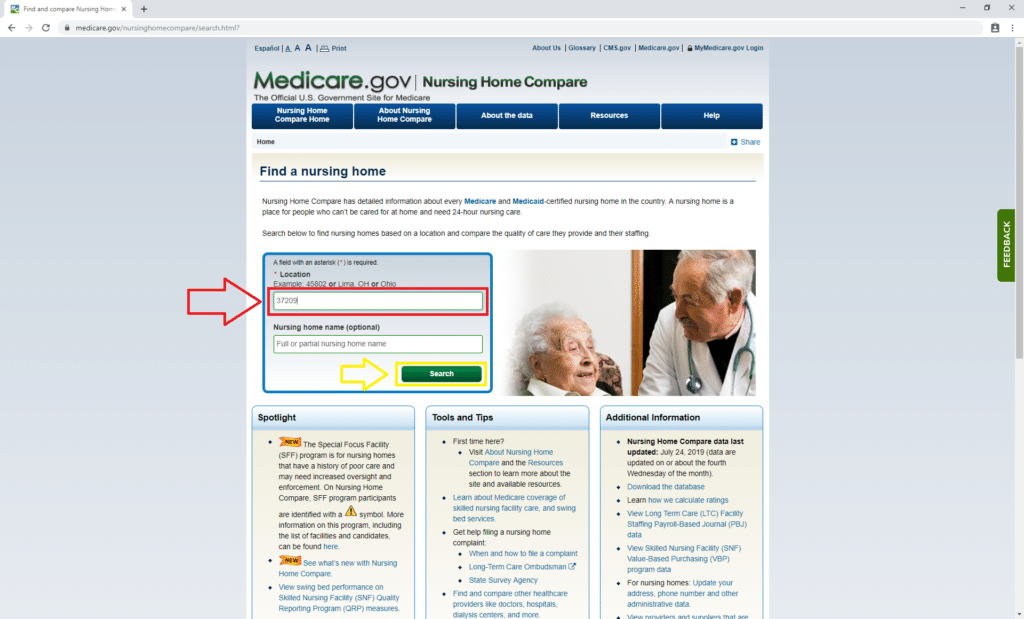
Once you’ve determined your budget and medical needs, you can start looking for nursing homes in your area. Use Medicare.gov’s Nursing Home Compare tool to find local Medicare-certified facilities. Click here to get started.
Enter your zip code in the search bar and click “Search.” We used our home office’s zip code of 37209.
The next page you see will be a list of nursing homes in your area. You can sort the list by different criteria. For demonstration purposes, we’re only sorting the facilities by overall rating from highest to lowest. To do this, click on the down arrow under “Overall Rating.”
After you sort the list by your most important criteria, call different facilities to get an idea of price and bed availability. If a nursing home sounds like a good fit, schedule an appointment to tour the facility with your nursing home checklist in hand. You may want to visit the facility more than once before you commit to it.
List of Medicare/Medicaid-Certified Nursing Homes Near Me
We are working on expanding our research for you. We’ve started putting together lists of nursing homes in certain cities. Don’t see your city yet? Send us a message to request a list of nursing homes available in your city.
If nursing home care isn’t feasible, you may have other options for long-term care. Talk to your family, healthcare provider, a counselor, or a social worker to see what’s available in your area.
According to Medicare.gov, you may have several options including:
Home and community-based services
Accessory Dwelling Units (in-law apartments)
Subsidized senior housing
Continuing Care Retirement Communities (CCRCs)
Group living arrangements
Hospice and respite care
*PACE (Program of All-inclusive Care for the Elderly)
If you need coverage for long-term care, a licensed agent with Medicare Plan Finder may be able to help you find it. Your agent may be able to find long-term care, life insurance, or Medicare Advantage plans that cover nursing home and/or assisted living facilities. To arrange a no-cost, no-obligation appointment, call 844-431-1832or contact us here today.
What Is a Medicare SELECT Plan?
Medicare is a giant healthcare system that helps eligible people receive medical services. However, it doesn’t cover everything health-related. One tool that people use to afford healthcare is called a Medicare SELECT plan.
What Is Medicare SELECT?
A Medicare SELECT plan is a type of Medicare Supplement (Medigap) plan. Medigap plans are private insurance policies that can help close the gap between your coverage and what you pay. Medicare SELECT plans require you to use a specific network of medical facilities and healthcare providers.
How Does a Medicare SELECT Plan Work?
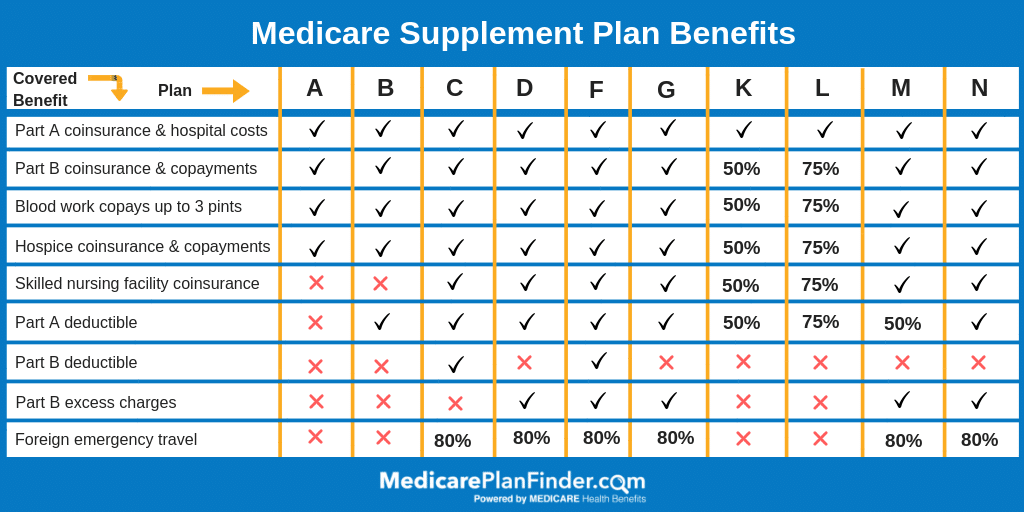
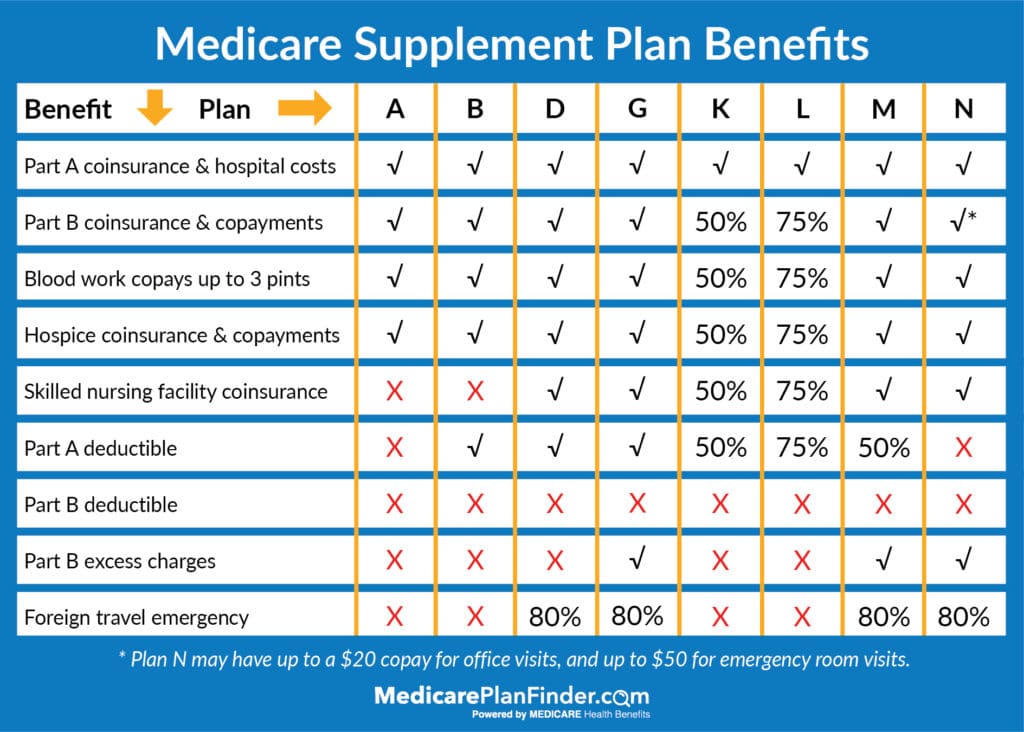
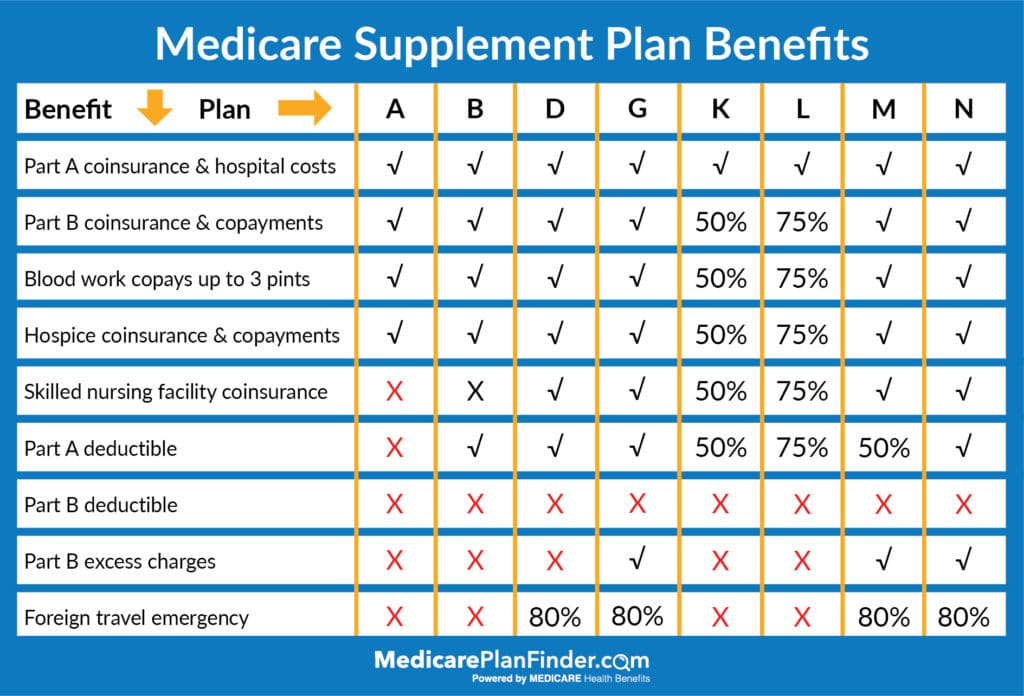
A regular Medicare Supplement plan provides coverage anywhere that accepts Medicare. In 2019, there are 10 standardized Medigap plans you can enroll in. Covered services depend on which “letter” you buy, but each letter offers the same coverage in every state.
Medicare Supplement Plans Comparison Chart
Plans that cover the Medicare Part B deductible (Plan C and Plan F) will not be available to anyone newly eligible for Medicare after January 1, 2020. If you qualify for Medicare and want coverage for those items now, talk to an agent today!
Medicare SELECT policies are different from other Medigap plans because they aren’t accepted everywhere that takes Medicare. Also, Medicare SELECT is different because not all 50 states have plans available.
Medicare SELECT premiums depend on a variety of factors, but because they feature smaller networks than normal Medigap plans, Medicare SELECT premiums may be less.
Is Medicare SELECT Different Than Medicare Advantage?
Medicare SELECT is different than Medicare Advantage because of what the plans cover. Because Medicare SELECT is a type of Medicare Supplement policy, it only covers financial items such as deductibles, coinsurance, and copays.
Like Medigap policies, Medicare Advantage plans are private insurance policies. However, Medicare Advantage plans cover medical services, and they can offer supplemental benefits such as vision, hearing, dental, and fitness classes. You must choose either a Medigap plan or a Medicare Advantage plan. You cannot have both.
Certain Medicare Advantage plans called HMOs are a lot like Medicare SELECT, because they can feature smaller networks of providers than Medicare Advantage PPOs or regular Medigap plans.
When Can I Buy Medicare SELECT?
According to the Medicare Rights Center, the best time to enroll in a Medigap plan is during your Open Enrollment Period (OEP), which is the six months after you’ve enrolled in Medicare Part B.
If you miss your Open Enrollment Period, you can buy a Medigap plan when you have a guaranteed issue right. For example, you have guaranteed issue within “63 days of losing or ending certain kinds of health coverage.”
You may also have a guaranteed issue right if you enrolled in a Medicare Advantage plan when you were first eligible for Medicare and disenrolled within one year. Other circumstances that may allow you to have guaranteed issue are if your private Medicare plan ends coverage or you move out of the plan’s service area.
If you decide a Medicare SELECT or any Medicare Supplement policy isn’t for you, you can cancel within 30 days of starting coverage. However, you should cancel with caution, because you may not be able to buy another policy depending on where you live, and you might get charged more because of your health.
If you buy a Medicare SELECT policy and you don’t like it, you can switch to a standard Medicare Supplement plan within 12 months of your Medicare SELECT policy taking effect.
Learn More About Medicare SELECT
Medicare SELECT plans aren’t available in every state. A licensed agent with Medicare Plan Finder can show you what’s available in your area and help you make a decision. Our agents are highly trained and may be able to find a plan that fits your budget and lifestyle. Call 844-431-1832 or contact us here to set up a no-cost, no-obligation appointment today.
Find Medicare Plans | Medicare Plan Finder
2019 Medicare Donut Hole: Part D Changes and Costs
According to the Henry J Kaiser Family Foundation (KFF), 43 million Medicare beneficiaries are enrolled in a Part D plan. This accounts for 72% of Medicare beneficiaries nationwide!
Medicare Part D started in 2006, and back then, you were required to pay 100% of the costs for brand name drugs. That percentage has lowered over the years, and better yet, 2020 brings super exciting news regarding the Medicare Part D donut hole.
How Does the Medicare Part D Donut Hole Work in 2019?
The Medicare donut hole is a gap in your Part D plan that starts after you’ve spent your deductible ($415 or less) and exceeded the initial coverage limit ($3,820) in total out-of-pocket costs.
You are in the gap until you reach the annual out-of-pocket threshold ($5,100). During this time, you are required to pay more for your prescriptions. This encourages you to choose generic options whenever possible.
Once you pass the donut hole and reach the catastrophic coverage period, you only have to pay 5% of all drug costs for the remainder of the year.
How Much Is the Donut Hole in 2019?
In 2019, you will pay 25% of brand-name drugs in the donut hole. This is the same as what you would pay before you enter the donut hole, meaning the Medicare donut hole is completely closed for brand-name drugs.
However, you will be responsible for up to 37% of generic drug costs in 2019. The plan is for this to decrease to a max of 25% in 2020, effectively closing the donut hole. Other Medicare donut hole 2019 costs include:
Initial Deductible: increasing by $10 ($405 to $415)
Initial Coverage Limit: increasing by $70 ($3,750 to $3,820)
Out-of-Pocket Threshold: increasing by $100 ($5,000 to $5,100)
In 2019, you’ll know if you’re in the donut hole based on your “EOB” notice. The EOB is an “Explanation of Benefits.” If you have a Part D plan, you should be receiving this every month.
The notice will tell you how much you’ve spent for the year on covered drugs and whether or not you’ve reached the coverage gap. Some people may never reach it – it depends on how much you’re spending on your prescriptions.
What Drugs are Covered in the Hole?
Your “formulary” does not change when you’re in the donut hole. The drugs that are listed on your formulary are the drugs that you can receive coverage for.
When Is the Donut Hole Going Away in 2020?
The Medicare Part D donut hole is scheduled to close completely in January 2020. Thanks to the Bipartisan Budget Act of 2018, the gap has closed a whole year ahead of schedule. However, the gap is only closing for brand-name drugs.
The gap for generic drugs will decrease, but will not be completely eliminated until 2020. This is great news for beneficiaries like you because generic drugs already have a lower price point – it’s the brand-name drugs that typically cause hardship in the donut hole.
What Will My Part D Costs Be in 2020?
The standard Part D deductible is $435 in 2020. After you meet the deductible, you’ll pay 25% of both brand name and generic drug prices.
Once you pay $4,020 out-of-pocket, you’ll still only pay 25% of your prescription drug costs, instead of entering the donut hole.
After you pay $6,350, you enter Catastrophic Coverage, and you’ll pay 5% of your prescription costs.
Medicare Pharmacist | Medicare Donut Hole 2020
What Are Your Medicare Part D Donut Hole Coverage Options?
Original Medicare (Part A and B) does not cover prescription drugs. If you are looking for prescription drug coverage, you have two options. You can enroll in either a Medicare Advantage or Part D plan.
If you are exclusively looking for prescription drug coverage, Part D may be right for you. If you are looking for prescription coverage along with other benefits like hearing, dental, or vision coverage, a Medicare Advantage plan is probably best for you.
Trying to decide between Medicare Advantage or a Part D plan can be difficult. Our licensed agents can help you enroll in the plan that best fits your unique needs and budget.
They can answer any questions or concerns you may have. Plus, our agents are contracted with most major carriers in your state, so there is no bias when we help you select a plan. If you’re interested in arranging a no-cost, no-obligation appointment, call us at 844-431-1832 or contact us here.
This post was originally published on January 10, 2019, and updated on October 16, 2019.
What Does Medicare Cost in 2019-2020?
Surprise! Medicare is not free, as some may believe. Medicare beneficiaries can owe a variety of charges, including monthly premiums, yearly deductibles, and per-service copayments and coinsurance. What does that mean?
Coinsurance = the percentage of a medical service that you owe
Copayment = the fee you pay upon receiving a medical service or good
Deductible = the amount you will owe before your coverage begins
Premium = the amount you owe your insurance company or Medicare every month
Costs can change every year. We’ll keep this guide up-to-date so that you can know what to expect from your Medicare coverage this year.
How Much Does Medicare Cost at Age 65?
Medicare costs do not change as you age, but they can change if you wait too long to enroll. If you age into the Medicare program and sign up when you turn 65, it will cost $144.60 per month (2020) for Part B, unless you make too much money, in which case you’ll pay more. You’ll also play anywhere from $0-$458/month (2020) for Part A, depending on how much you’ve worked and contributed to Medicare taxes.
However, if you miss your Initial Enrollment Period (which begins three months before you turn 65 and ends three months after), you may be charged a late enrollment penalty fee. The penalty means that your premiums can be up to 10% higher than the base cost. Don’t wait to enroll!
Turning 65 Checklist
What Does Medicare Cost Per Month in 2019-2020?
Your monthly Medicare costs will depend largely on what you qualify for and what you’ve signed up for.
Part A costs depend on how much you’ve worked. If you:
Worked and paid Medicare taxes for over 39 quarters of your life? You won’t pay a Medicare Part A premium in 2019
Worked and paid Medicare taxes for 30-39 quarters of your life? You’ll pay $252/month in 2020
Worked and paid Medicare taxes for less than 30 quarters of your life? You’ll pay $458/month in 2020
Additionally, if you are eligible for retirement benefits from either Social Security or the Railroad Retirement Board, you will not owe a Part A premium.
The Part A inpatient hospital deductible has increased from $1,340 in 2019 to $1,408 in 2020.
Despite these premium costs, you may incur other costs, like deductibles, coinsurance, and copayments.
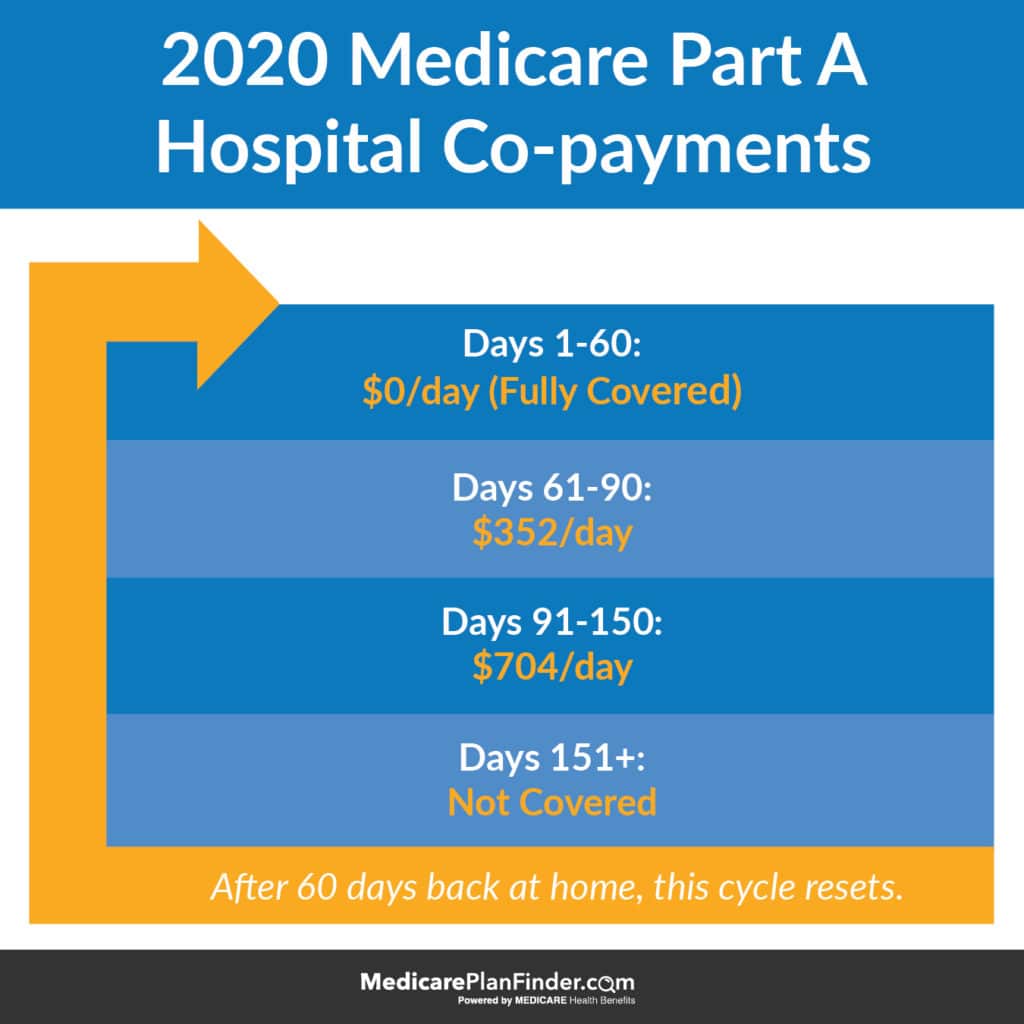
Hospital copayments depend on how many days you’ve been in the hospital. Your first 60 days are completely covered, then you’ll face copayments. Remember that you will also have to pay your deductible first ($1,408 in 2020).
2020 Medicare Part A Copayments
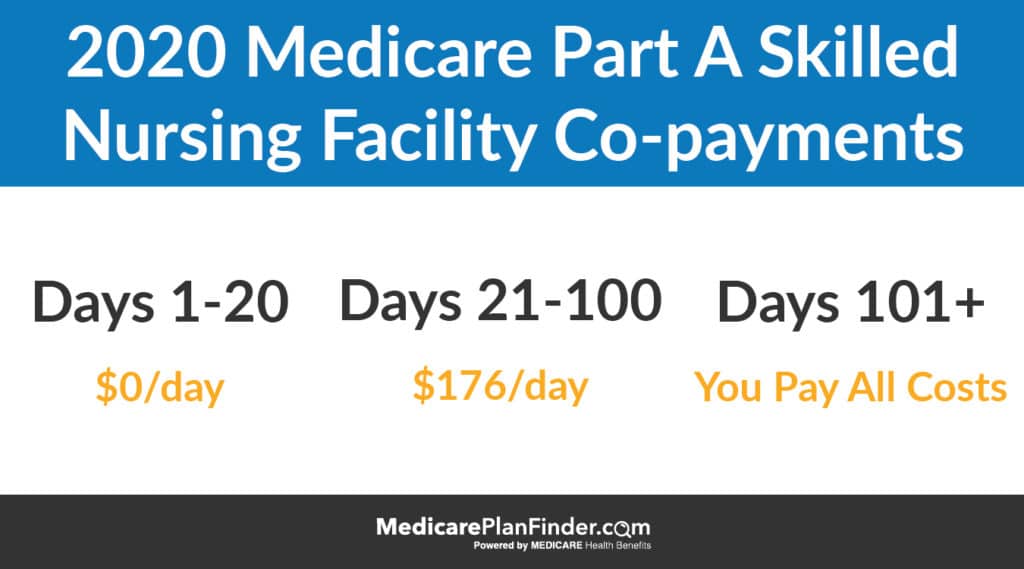
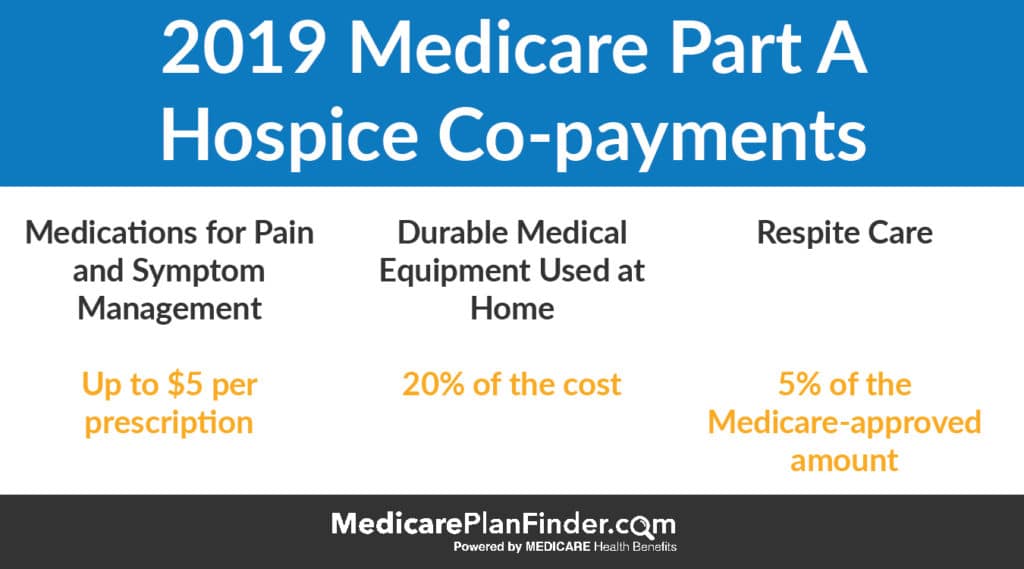
Hospice and nursing facilities are a bit different. The charts below explain some of the hospice and nursing facility costs that you may incur with Part A.
2020 Medicare Part A Skilled Nursing CopaymentsMedicare Part A Hospice Copayments | Medicare Plan Finder
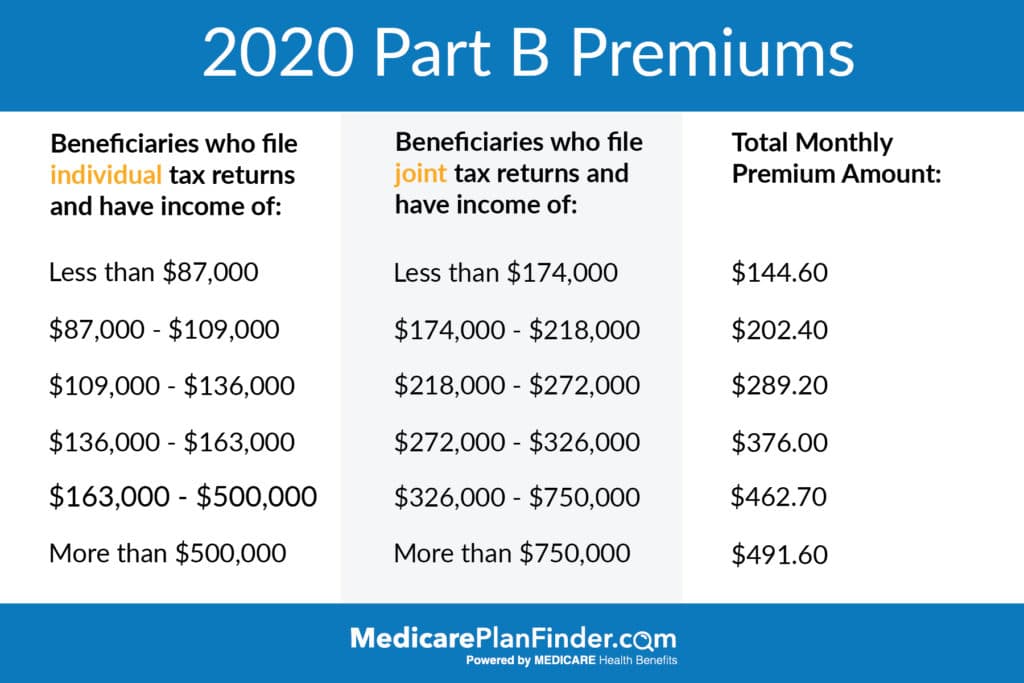
The standard monthly premium for Part B in 2020 is $144.60, but that can change based on your income.
An estimated 3.5% of beneficiaries (2 million) will pay less than this amount due to the Social Security “hold harmless” provision which prevents the increased premium to exceed the increase in Social Security benefits.
Additionally, if you make more than $87,000 a year, your monthly Part B premium will be adjusted based on your income. The income-based 2020 premiums for Part B are as follows:
2020 Medicare Part B Premiums
Will Medicare Part B Premiums Increase in 2019?
Generally, Medicare premiums change once per year. The change has historically been incremental and has even been a decrease in certain years.
The standard Part B premium decreased in 1989 and 1996. Since 2000, it has been steadily increasing to the $144.60 that we have today.
2020 Medicare Part B Deductible Increase
The Medicare Part B deductible increased from $185 in 2019 to $198 in 2020, an increase of $12.
Medicare as a whole has been trying to discourage beneficiaries from taking advantage of small deductibles, as evidenced by the removal of Medigap Plan F from the market.
Who Has to Pay for Medicare Part B?
Everyone enrolled has to pay the Medicare Part B premium, but some people may qualify for savings. For example, if you are eligible for a Medicare Savings Program, you may be able to have your Medicare Part A and B premiums, deductibles, coinsurance, and copayments covered (depending on which program you qualify for).
How to Save on Medicare Premiums in 2020
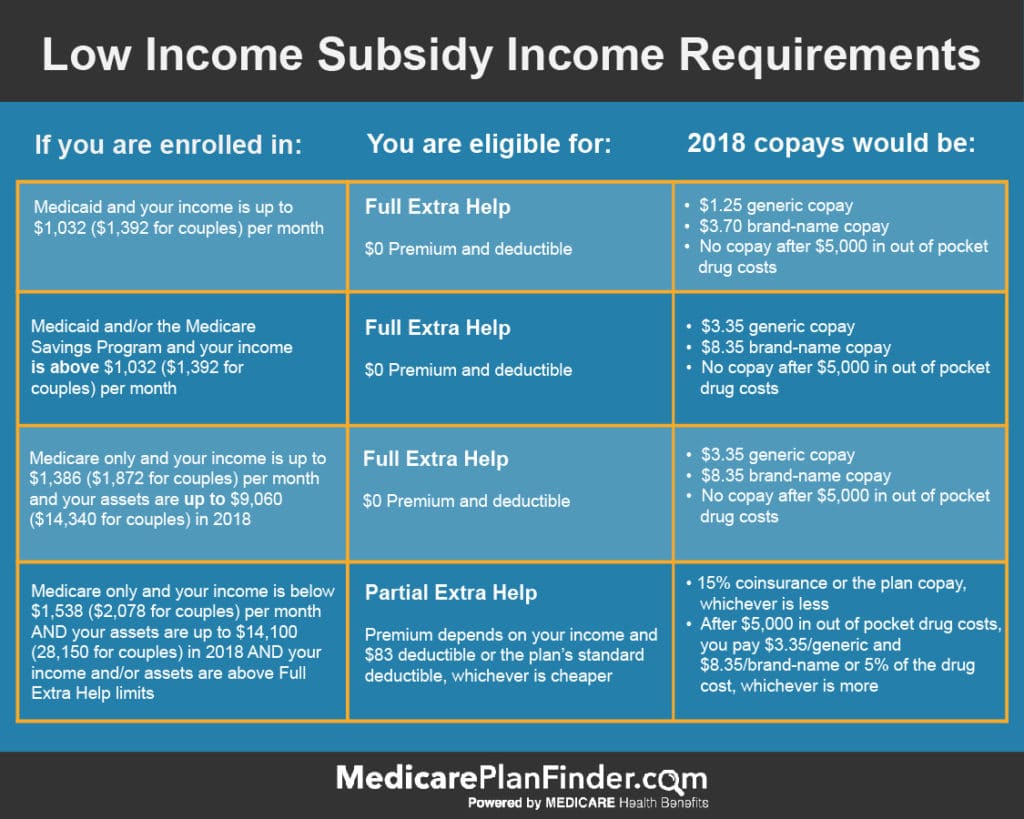
You may be able to save on Medicare premiums by qualifying for Low-Income Subsidies (LIS), also known as Medicare Extra Help, or a Medicare Savings Program (MSP). LIS provides help with Medicare prescription costs, and MSPs provide help with a variety of other costs, such as premiums and deductibles.
There are four major MSPs:
Qualified Medicare Beneficiary Program (QMB). Can help pay premiums for Part A and Part B, as well as copays, deductibles, and coinsurance. An individual may qualify in 2019 with an income up to $1,061 per month or $1,430 per month for a couple. If you qualify for QMB, you may also be eligible for Extra Help (LIS) paying for Part D prescription coverage.
Specified Low Income Medicare Beneficiary Program (SLMB). Can help pay premiums for Part B. A single person may qualify in 2019 with an income up to $1,269 per month or $1,711 per month for a couple. If you qualify as a SLMB, you’re may be eligible for LIS paying for Part D prescription coverage.
Qualified Disabled and Working Individuals Program (QDWI). Can help to pay Part A premiums. This MSP is for disabled people who lost their premium-free Medicare Part A when they went back to work. The income limits for QDWI are $4,249 per month for an individual, and $5,722 for a couple in 2019. The asset limit is $4,000 for an individual and $6,000 for a couple.
In 2019, people with LIS did not pay more than $3.40 for generic drugs and $8.50 for brand-name drugs!
To qualify for LIS, you must have a monthly income of less than $1,405 for an individual or less than $1902 for a couple in 2019. You must also
Have Original Medicare (Part A and Part B) coverage
Have prescription drug coverage (either a Medicare Part D plan or a Medicare Advantage plan with prescription drug benefits)
Have American citizenship
Not have savings, investments, and real estate valuing more than $28,150 if you are married or $14,100 if you are single
Medicare Advantage and Medicare Supplement 2019–2020
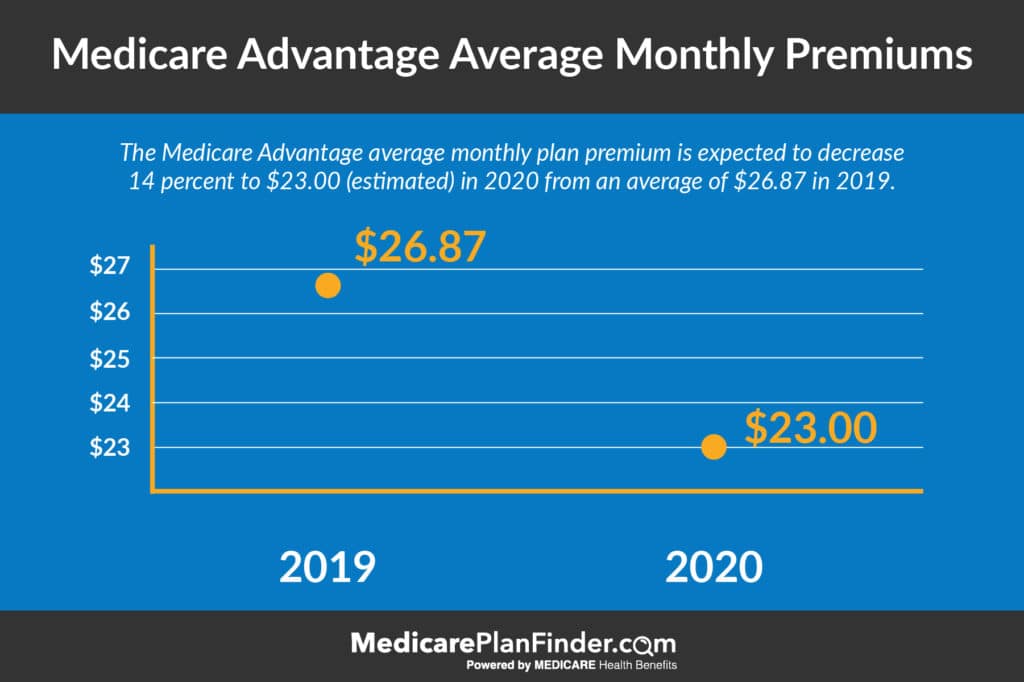
In 2020, Medicare Advantage premiums have decreased on average.
Medicare Advantage Premiums 2020
What does this mean for you? If your premium went up and you need a better option, the time is now! The annual enrollment period is October 15 through December 7. During this time you can switch or enroll in the best plan that fits your needs and budget. Our licensed agents can answer any questions you may have. If you’re interested in scheduling a no-cost, no-obligation appointment, fill out this form or call us at 844-431-1832.
This post was originally published on November 1, 2018, and was last updated on November 5, 2019.
Medicare and SSI (Supplemental Security Income)
There’s SSI, SSDI, Social Security retirement, Medicare and Medicaid…so many government programs. It can be hard to keep track! Sometimes, qualifying for one government program can indicate eligibility for another. Do you know what you’re eligible for?
Today we’re going to dive into SSI, the Social Security Administration’s Supplemental Security Income program, and how it relates to other benefits.
What is Supplemental Security Income (SSI)?
SSI is a government program that is funded by “general tax revenues” as opposed to Social Security taxes. The program provides cash assistance for the purpose of paying for basic needs like food, clothing, and shelter. SSI is only for those who have little or no income/resources and are aged (over 65), blind, or disabled.
SSI Benefits
If you qualify for SSI, you’ll receive a monthly cash benefit. This benefit is determined by the FBR, or Federal Benefit Rate. The 2019 FBR is $771 for single people and $1,157 for married couples. This amount is subject to change each year.
Some states also add money to this based on where you live. Arizona, Arkansas, Georgia, Mississippi, Oregon, Tennessee, Texas, and West Virginia do NOT add money to the SSI benefit.
Can I Get Medicare if I Have SSI?
Not necessarily. It may be possible to qualify for both programs. You can qualify for Medicare if you:
If any of those things apply to you and you are ALSO eligible for SSI, then you may be able to have both programs.
Those who do have Medicare and SSI will be automatically eligible for “Extra Help,” also called LIS or Low-income Subsidies. The Extra Help program provides savings on Medicare prescription drug coverage.
Click here to read more about Medicare Extra Help.
Maybe. There are 32 U.S. states (and D.C.) that will automatically qualify you for Medicaid if you have SSI. However, if you live in Alaska, Connecticut, Hawaii, Idaho, Illinois, Indiana, Kansas, Minnesota, Missouri, Nebraska, New Hampshire, Nevada, North Dakota, Ohio, Oklahoma, Oregon, Utah, Virginia, or the Northern Mariana Islands, you will have to apply for SSI and Medicaid separately, and one does not automatically qualify you for the other.
What is the Difference Between SSI and SSDI?
SSI and SSDI are very similar programs, and their names are similar, too, so it’s easy to get confused! The main difference between the two is that SSI is need-based and does not take work history into account, while SSDI candidates have earned “work credits” by working for a certain number of years and contributing to Social Security taxes.
Additionally, people with SSI are usually able to receive Medicaid and food stamps, as well. On the other hand, people with SSDI automatically qualify for Medicare after two years in the program.
“Blind” is defined as “central visual acuity for distance of 20/200 or less in your better eye with use of a correcting lens” or “visual field limitation in your better eye…”
Disabled means that you have a physical or mental impairment which offers “severe functional limitations,” may result in death, and has lasted for at least one year.
Living with limited income and resources
2019 resources cannot exceed $2,000 for a child or individual adult and $3,000 for an adult couple.
Income refers to money earned from work, benefit programs, and free food or shelter.
Resources refer to cash, bank accounts, stocks, bonds, land, cars, personal property, life insurance, and other valuable goods.
*If you give away or sell your resources in order to qualify for SSI, you may become ineligible for SSI for up to 36 months.
A U.S. citizen, national, or qualified alien
A legal resident of a state, D.C., or the Northern Mariana Islands
Not absent from the U.S. for 30 or more consecutive days
Exceptions may be made for students studying abroad and for children of military parents who are stationed overseas.
Not confined to a hospital, prison, or other institution at the government’s expense
Also applying for other cash benefits and programs
Social Security work incentives give disabled and blind SSI recipients an opportunity to go back to work without losing their benefits.
First, there is an “earned income exclusion.” The SSA does not count the first $65 plus half of the amount over $65 when determining SSI eligibility. What this basically means is that your SSI benefit will only be reduced by $1 for every $2 you earn after the first $65.
For example, let’s say you work and earn $85. The first $65 doesn’t count, so the SSA is looking at your extra $20. Of that $20, they’re only going to count half. That means you’re only being “penalized” for $10 of the $85 you made. That penalty means that your benefit will be reduced by $10. You still get to keep the rest of your benefit, and you’ve basically made an extra $75.
Additional incentives:
Students under 22 may receive exclusions for up to $1,870/month (but not exceeding $7,550 in a calendar year)
Disabled and blind workers may receive exclusions for out-of-pocket expenses related to being able to work with your disability, such as car modifications or special software applications.
PASS (Plan to achieve self-support):
Blind or disabled persons can set aside income or resources towards reaching an employment goal
Kids living with parents may exclude some of their parents’ income/resources
The “Ticket to Work” and Work Incentive Improvement Act of 1999 was passed to help people between the ages of 18 and 64 with Social Security benefits return to work or find higher-paying jobs. The “ticket” program provides free employment services to eligible beneficiaries. The service can help you design a career plan, achieve milestones, and find jobs.
How to Apply for SSI
Even if you are not sure whether or not you are eligible, it may be a good idea to apply for SSI as soon as possible so that you don’t miss out on valuable benefits. There is no charge to complete the SSI application.
Call Social Security at 1-800-772-1213 (TTY 1-800-325-0778) and make an appointment
Visit your local Social Security office (expect a wait if you don’t have an appointment)
If you are applying in person, be sure to bring financial and medical documentation with you. You may need proof of age, citizenship status, medical history/disability, income, and resources.
If you or someone you know needs help with their application, you must have an “Appointment of Representative” form (Form SSA-1696).
If you or someone you know does not speak English well, you may not need a representative. Social Security can provide a free interpreter (or you can use a bilingual friend or family member).
If you or someone you know is deaf or hard of hearing, you can bring an ASL interpreter or use a Social Security Administration interpreter at no cost.
Medicare SEP Changes 2020: When You Can Enroll If You’re Eligible for a DSNP or LIS
DSNPs (Dual Special Needs Plans) are Medicare Advantage plans for people who are eligible for both Medicare and Medicaid. LIS (Low Income Subsidy), or Medicare Extra Help is a federal program that helps Medicare beneficiaries save money on prescription drugs.
If you are eligible for either DSNPs or LIS, your enrollment periods might be a bit different from others.
Am I Eligible for LIS?
If you’re eligible for Medicare and you make less than 150 percent of the Federal Poverty Level, you may qualify for LIS. You can also automatically qualify for Extra Help if you’re already on SSI or you qualify for a DSNP.
What Does LIS Cover?
LIS helps qualifying people pay for prescription drugs and it covers items such as Part D premiums, deductibles, and the “Donut Hole”.
LIS coverage is offered on a sliding scale. That means the subsidy provides more or less help depending on your qualifications.
For example, if you’re single and you qualify for full LIS and Medicare only, you’ll pay no more than $3.40 for covered generic drugs and $8.50 for covered brand-name drugs. You will have no copay once you spend $5,000 out-of-pocket for covered prescription drugs.
What are Medicare DSNPs (Dual-Eligible Special Needs Plans)?
DSNPs cover your Original Medicare premiums and services, and, since they’re Medicare Advantage plans, they can offer additional benefits* such as:
Many DSNPs have $0 monthly premiums, and if you see healthcare providers in your plan’s network, you shouldn’t have to pay Medicare deductibles and copays.
*Plan benefits and availability depend on many different factors such as location and carrier. Talk to your licensed agent to learn about available plans and covered services.
What Are the Changes to My SEP?
In the past, if you qualified for a lifelong SEP, you could enroll in a new DSNP, Medicare Advantage, or Part D plan up to once a month for the entire year.
In 2019 and 2020, if you’re eligible for a DSNP, LIS, or you only qualify for Medicare Savings Programs (MSPs) such as the Qualified Medicare Beneficiary (QMB) program or the Specified Low-Income Medicare Beneficiary (SLMB) program, the 2019-2020 CMS guidelines state that you can enroll in a new plan or drop coverage once per quarter for the first three quarters of the year (January – September).
Any changes you make during this time will become effective on the first of the month following the date you made the change. For example, if you enroll in a new DSNP plan on February 10, that change will become effective on March 1. You would not be able to make another change until the next quarter.
Q1: January – March
Q2: April – June
Q3: July – September
Q4: October – December
So, what does that mean for the rest of the year? Well, it means that you’ll fall into the AEP like everyone else.
The Annual Enrollment Period (AEP), which is October 15 to December 7, is a time when anyone can make changes to their existing Medicare coverage. Any AEP changes will take effect on January 1 of the following year. For example, if you make a change during AEP on November 15, that change will become effective on January 1.
Get the Medicare Health Insurance You Need Today
A licensed agent with Medicare Plan Finder may be able to help you find the coverage you need to stay in optimal health. Our agents are highly trained and they can find out what’s available in your area and help you make the right decision.
Our agents focus on the individual and offer an unbiased approach to helping you enroll in Medicare plans. To schedule a no-cost, no-obligation appointment, call 833-431-1832 or contact us here now.
How to Use Medicare Easy Pay
In this digital age, it’s now easier than ever to pay your Medicare bills. There’s no reason to forget to send your checks out or to have to go to the post office to buy stamps anymore. Paying your bills can be as easy as clicking a button!
We’re available to answer all your burning questions about who has to pay what for Medicare, how to pay your Medicare bills, and more.
Medicare Easy Pay
Do I Have to Pay for Medicare?
We get this question a lot, and we understand why you may be confused or upset. If you were employed for any extended period of time in your life, you’re probably thinking, “I already paid for Medicare through taxes!” It’s true that most people paid Medicare taxes during their working careers, but there are still some costs involved in Medicare for most people.
Those Medicare taxes that you paid all those years certainly helped fund the Medicare program, but it’s not enough. Healthcare is expensive!
Medicare parts A and B are different. If you worked for at least 39 quarters, you may not have to pay a premium for Part A at all. However, anyone who does not qualify for financial assistance will owe a premium for Part B. The Part B premium can change based on income, but the standard in 2020 is $144.60/month.
If you worked over 39 quarters (about ten years), your Part A premium will be $0
If you worked 30-39 quarters, your Part A premium will be $252 in 2020
IF you worked for less than 30 quarters, your Part A premium will be $458 in 2020.
2020 Medicare Part B Premiums
Medicare Premiums Deducted From Social Security Payments
If you have low income and receive Social Security assistance, you may receive premium-free Medicare.
Depending on your income, some people with Social Security benefits may still have to pay for Medicare. However, you can have your Medicare payments automatically deducted from your Social Security benefits.
You will receive a bill in the mail for your Medicare payments, unless one of the following applies to you:
If you receive Social Security benefits, your payments may be automatically deducted from your benefits.
If you receive Railroad Retirement benefits, your payments may be automatically deducted from your benefits.
If you retire from civil services, your payments may be automatically deducted from your annuities
Once you receive your bill, there are a few ways you can pay it. You can pay directly through your bank (set this up through your bank), you can send in a check or money order, you can pay by debit or credit card by filling in the card information on your bill slip and mailing it back in, or you can sign up for Medicare Easy Pay, a free service which will automatically deduct the premium from your bank account.
Keep in mind that aside from your premiums, you may still have to pay copayments when you visit a doctor or other provider.
If your payments are automatically deducted from your benefits or if you’re signed up for Easy Pay, you will receive a statement in the mail. The statement and will say “This is not a bill,” somewhere on it. That is just a statement telling you what was taken from your account, and you will not have to send in money. Don’t let this confuse you, you don’t want to pay twice!
How to Get More Money From Social Security Disability
Some Medicare Advantage carriers actually offer a program that can put more money back in your social security check. Some plans will give you a discount on your Medicare Part B (the part that pays for your doctor visits). You’ll see this discount reflected in your Social Security benefits since less money will be taken out for Medicare.
What Is Medicare Easy Pay?
Medicare Easy Pay
Medicare Easy Pay automatically deducts your Medicare premium from a designated checking or savings account. You’ll still get a “Medicare Premium Bill” in the mail, but it will say, “This is not a bill.” It will serve as a statement letting you know that your premium has automatically been deducted from your bank account.
If you prefer to not have your Medicare premiums automatically deducted, there are a few other ways you can pay:
You can sign onto MyMedicare.gov and pay your premiums online with your credit card or debit card.
If you receive Social Security benefits, you can have your Medicare premiums deducted from your benefits.
If you prefer to pay by check or credit card, you can return your Medicare bill with a check or credit card number by mail.
Using Medicare Easy Pay will save you time and prevent you from accidentally forgetting to pay your premiums.
How to Set up Medicare Easy Pay
Enrolling in Medicare Easy Pay and paying Medicare online is easy! All you need to do is fill out this Medicare Easy Pay form and submit it to the following address.
It can take up to 6-8 weeks to process, so make sure you continue to pay your bill until your Medicare Easy Pay becomes active.
Once it’s active, you’ll notice that your premium is deducted from your bank account on the 20th of the month. You’ll see it on your bank statement as “Automated Clearing House (ACH).”
Mail your Medicare Easy Pay form to:
Medicare Premium Collection Center PO Box 979098 St. Louis, MO 63197-9000
How to Cancel Medicare Easy Pay
If you need to change your Medicare Easy Pay bank account, address, or any other information, resubmit your Medicare Easy Pay form but select the “change” option.
If you no longer want to use Medicare Easy Pay for any reason, resubmit your Medicare Easy Pay form but select the “stop” option. Complete all the boxes in the form so that Medicare can locate your information to make changes.
Medicare Advantage Payment
If you have a Medicare Advantage plan, your plan is hosted by a private carrier. That means that instead of paying Medicare directly, you’ll be paying your carrier.
Each carrier hosts their billing differently. You’ll likely need to either send in a check or pay online. Check with your plan details or your carrier website to learn how to make a Medicare Advantage payment. A Medicare Plan Finder licensed agent may be able to help you figure it out.
Find Medicare Advantage Plans | Medicare Plan Finder
Part D Payment
Your Part D (prescription drug plan payment) will differ based on the type of prescription drug plan coverage you have.
If you have an MAPD (Medicare Advantage Prescription Drug Plan), your Part D/prescription drug coverage is included in your Medicare Advantage plan and you will most likely only have premium to pay each month. I
f your prescription drug plan is not included in your Medicare Advantage plan, you will have to look into your individual Part D plan to find a billing address to mail checks to or a website to enroll in digital payments.
Medicare Advantage is a way to wrap up your hospital coverage, doctor coverage, prescription drug coverage, and extra coverage (dental, vision, hearing) into one plan with one premium.
Medicare Supplement plans are a way to get coverage for your deductibles, coinsurance, and copayments.
If you didn’t do this in your Initial Enrollment Period (IEP), you have the chance to every year during AEP (the annual enrollment period), from October 15 through December 7.
What Happens If I Don’t Pay My Premiums on Time?
If you don’t pay your Part B premiums on time, you could lose coverage. It won’t happen immediately, however.
You have a 90-day grace period after the due date. Once the grace period passes, Medicare will send you a letter letting you know that you have 30 days to pay the bill or you will lose coverage. That makes a total of four months to pay your bill before Medicare will stop paying for covered services.
Private insurance plans (Medigap, Part D, or Medicare Advantage) may treat late payments differently. Check with your plan carrier if you have questions about the policies.
Still Need Help?
If you need help to pay Medicare online, one of our agents may be able to help you set it up! Give us a call and we’ll send a licensed agent your way to help you figure it out and make sure you’re in the best plan for your health and financial needs. Call us at844-431-1832 or contact us here today.
Contact Us | Medicare Plan Finder
This post was originally published on October 19, 2017, by Anastasia Iliou. The latest update was completed on October 8, 2019, by Troy Frink.
A Guide to Medicare Coverage for Dementia
A Guide to Medicare Coverage for Dementia
Dementia is a decline in mental capacity that becomes severe enough to hinder a person’s ability to function. According to the Alzheimer’s Association, one-third of Americans die with some form of dementia.
Medicare Parts A and B (Original Medicare) will cover everything that’s medically necessary for dementia patients, but many other services won’t be covered.
Original Medicare dementia care may be limited, but certain Medicare Advantage plans offer coverage for more services that can include unexpected offerings like meal delivery.
Medicare Coverage for Dementia Patients Clarified
Doctor Explaining Medical Treatment for Dementia | Medicare Plan Finder
An Original Medicare plan will cover services that your doctor deems medically necessary. Medicare Part A covers inpatient hospital care, and Medicare Part B covers outpatient care and medical expenses such as doctors’ appointment costs.
Original Medicare will pay for the first 100 days of care in a skilled nursing facility (there may be some associated fees), and some Medicare Advantage (Part C) plans may include long-term care coverage as well as skilled nursing care.
Private insurance companies offer Medicare Advantage plans, so they have the freedom to cover benefits Original Medicare doesn’t. Medicare Part D or certain Medicare Part C plans cover prescription drugs such as cholinesterase inhibitors that can temporarily improve symptoms of dementia.
Medicare Advantage | Medicare Plan Finder
Medicare Supplements
Medicare Supplements (Medigap) plans can help cover the expenses that Original Medicare does not. Unlike Medicare Advantage plans, Medigap plans do not cover medical expenses, but they cover financial items such as Part A and B coinsurance and copayments. Even though Medigap and Medicare Advantage are two different types of plans, you cannot enroll in both at the same time.
Find Medicare Supplements | Medicare Plan Finder
Does Medicare Pay for Dementia Testing?
Medicare Part B covers cognitive testing for dementia during annual wellness visits. A doctor may decide to perform the test for patients who are experiencing memory loss.
The test consists of about 30 questions like, “What year is this?” to assess the patient’s memory and awareness. The test can be used as a baseline evaluation for future wellness visits and can be a valuable tool for catching dementia early.
Medicare Testing for Alzheimer’s
Dementia is a symptom that can result from many different diseases. Alzheimer’s disease is just one cause of dementia. The risk of developing Alzheimer’s increases with age and with a family history of Alzheimer’s.
There is a correlation between genes called apolipoprotein E (APOE) and Alzheimer’s, but those genes do not necessarily cause the disease. Medicare will not cover genetic testing for APOE genes.
Dementia as a SEP-Qualifying Condition
Medicare eligibles with dementia also qualify for specific Medicare Advantage plans called Chronic Special Needs Plans (CSNPs). These health insurance plans involve coordination and communication between the patient’s entire medical team to help ensure the patient gets the best possible care.
The best way to sort through the thousands of plans available and find the right CSNP for you is enlisting the help of a qualified professional by contacting us here.
If you’re diagnosed with dementia and already enrolled in Medicare Parts A and B, you will qualify for the Special Enrollment Period (SEP). The SEP allows you to enroll in new Medicare coverage or make changes to your existing CSNP whenever you need to instead of having to wait for certain times of the year.
Special Needs Plans | Medicare Plan Finder
Eligibility for Medicare Coverage for Dementia
If you meet the eligibility requirements for Medicare Parts A & B, you will also be eligible for the dementia coverage provided by Medicare. You can obtain Medicare coverage for dementia services if you are:
Age 65 or older
Any age and have a disability, or end-stage renal disease (ESRD)
Dementia patients are also eligible for other specific Medicare plans once they are officially diagnosed with the condition, like special needs plans (SNPs) and chronic care management services (CCMR.)
Medicare can also cover home health care that dementia patients often need. In order to receive this coverage, it must be certified as necessary by a doctor. The patient must also be classified as homebound, meaning they have trouble leaving the house without help.
Does Medicare Cover Memory Care?
Memory care is a specific type of long-term care for Alzheimer’s patients or people with dementia. Original Medicare will cover occupational therapy but does not cover assisted living facilities. However, certain Medicare Part C plans may include coverage for Medicare dementia care services such as adult day care or help to get dressed or to bathe.
Medicare dementia coverage is split between its component parts. Part A helps cover the cost of inpatient hospital stays, including the meals, nursing care, and medication that you need while you’re there. Meanwhile, Part B will cover the doctor’s services that you might receive during your stay in the hospital, such as testing or medical equipment.
Even more services can be covered by Part C, also called Medicare Advantage. In addition to everything covered by Parts A & B, these plans can also offer options for long-term and home care for dementia patients.
How Much Does Medicare pay for dementia care?
Each different part of Medicare will pay for its benefits in different ways. For example, Part A will cover the entire cost of your hospital or skilled nursing facility stay for the first 60 days. After this period, you will need to pay 20% coinsurance until day 90, when Part A will stop paying entirely.
Part B, on the other hand, will usually pay for 80% of all services that it covers. Medicare Supplement plans are often purchased to cover the remaining costs, and can also provide additional benefits to the patient.
Does Medicare cover long term care for dementia?
The long-term care insurance offered by Medicare depends on the nature of the service being provided to the patient. In many cases, the long-term care needed by dementia patients is classified as custodial care and won’t be covered by Medicare.
However, if your doctor prescribes a long-term care service as “medically necessary,” Medicare may help cover the costs. These exceptions can include services like hospice care, and part-time nursing care or occupational therapy provided in the home.
Does Medicare Pay for Home Health Care for Dementia Patients?
It is usually difficult to obtain coverage from Medicare for elderly care at home. However, it can completely cover some home health services that are deemed medically necessary by your doctor, including:
Physical and occupational therapies
Part-time skilled nursing care
Medicare social services
Most nursing home care is also classified as custodial care by Medicare, meaning it will not be covered. Medicare will cover custodial home health care for dementia patients only if it’s a part of hospice care.
Medicare Advantage plans, however, can offer many different home health benefits for those who suffer with dementia. Examples include personal care assistance, homemaker services, and meal delivery.
Does Medicare Cover Assisted Living for Dementia?
Original Medicare will not cover any services that are deemed custodial or personal care, including any that aid in typical activities of daily living, such as:
Eating
Getting Dressed
Bathing
Using the restroom
This rule also applies to assisted living and memory care facilities which provide these services. But depending on your state and the facility of choice, Medicaid may be able to help cover the cost of long-term custodial care provided in assisted living facilities.
Medicare Dementia Hospice Criteria
In order for Medicare to cover hospice care, your doctor must first document that you have less than six months to live. You or your durable power of attorney must sign documents indicating that you agree to accept care for comfort and that you waive other Medicare benefits.
What dementia services does Medicare not cover?
In almost all cases, Medicare will not cover any non-medical care services, such as:
Assisted-living or long-term care
Custodial services provided in a facility or in the home
Homemaker services
Meal delivery
There are exceptions to these rules, but the service in question must be recommended as medically necessary by your doctor. Medicare Advantage plans may offer coverage for these and other personal care services not covered by Medicare.
How to Cover the Gaps with Medicare and Dementia
Paying for dementia care can be daunting, even for Medicare beneficiaries. Both Parts A & B have deductibles you have to meet, and Part B only pays for 80% of its covered services. At the end of the day, a patient and their family may be left wondering how to pay for Alzheimer’s care.
The answer may come in the form of Medicare Part C, also called Advantage plans, which can pay for many of the custodial care costs not covered by Original Medicare. Another option may be a Medicare SNP, or special needs plan, which are geared toward patients with certain chronic conditions such as dementia.
Early Signs and Symptoms of Dementia
Dementia can have a variety of symptoms depending on the cause, as well as if the patient is in the early stages or late stages of the disease. However, some common signs symptoms include:
Cognitive changes
Loss of memory
Difficulty finding the right words during conversation
Getting lost while driving to and from familiar places
Difficulty with logical reasoning or solving problems
Difficulty with completing complex tasks
Difficulty with planning and organizing day-to-day activities
Difficulty with muscular coordination and motor functions
Being confused or disoriented
Psychological changes
Changes in personality
Depression
Anxiety
Inappropriate or irrational behavior
Paranoia
Agitation
Hallucinations
How to Find Memory Care
Medicare.gov has a tool to find nursing homes that accept Medicare for medical services. To get started, click here. Not all of these facilities have dedicated memory care teams, so you’ll need to contact them to verify their services.
Once you’re on the nursing home finder tool page, enter your zip code as shown below in red. We used 37209, which is our corporate headquarters’ zip code in Nashville, Tennessee. Then click “Search,” shown in yellow.
How to Find Memory Care Step 1 | Medicare Plan Finder
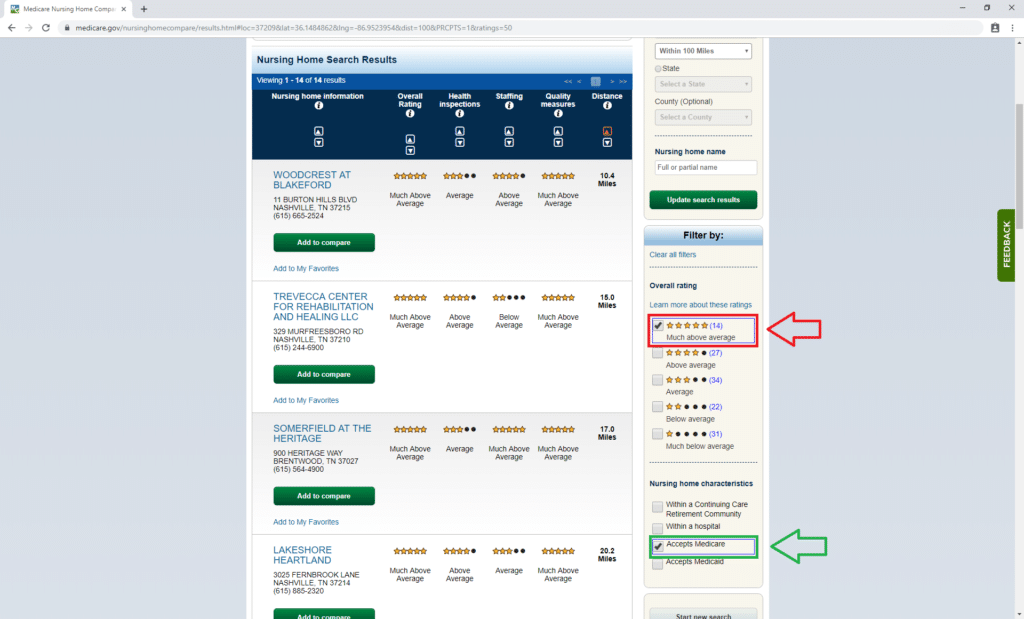
Then you’ll reach a list of nursing homes in your area. The nursing home finder tool lets you sort facilities by star rating, which is based on a scale of one to five.
Basically, the higher the rating, the better the care the facility provides. For demonstration purposes, we only chose to see homes that have a five-star rating (shown below in red) and that take Medicare insurance (in green.)
How to Find Memory Care Step 2 | Medicare Plan Finder
You may have to contact more than one facility to find the right one for you. Ask about costs and how they help patients with dementia. If one seems like it may be a good fit, ask to tour the home to really get a feel for it.
Resources for Families
Family members of dementia patients have access to a wide variety of resources to help them cope. The first step for helping your loved ones is to educate yourself about the disease and to learn how you can be the most supportive.
You should also look into support groups for your family so they can find like-minded people who are having similar experiences. Dementia should not be dealt with alone.
If you are a caregiver for a parent with dementia, you should consider important things such as who will have the power of attorney and make financial decisions for the patient at the end of his or her life. If you haven’t enrolled in a life or a final expense insurance policy, you should consider doing so now.
We Can Help You Find Medicare Coverage for Dementia
Dementia is difficult for everyone involved. If you or a loved one has dementia, we can help you navigate Medicare dementia care and find a Chronic Special Needs Plan that’s right for you. Set up a no-obligation appointment with a licensed agent by calling 844-431-1832 or contacting us here today.
Contact Us | Medicare Plan Finder
How to Find Medicare-Approved Mobility Scooters in my Area
According to the University of California’s Disability Statistics Center, about 6.8 million people rely on mobility scooters to get around their homes. Electric scooters may help give people independence and freedom who might otherwise be left in bed. If you’re looking for a Medicare-approved mobility scooter, first you have to qualify to receive one.
Your doctor must submit a written order stating that you have a medical need for a scooter to use at home.
You have a health condition that causes extreme difficulty moving around your house.
You can’t engage in daily living activities such as bathing, dressing, getting in or out of bed or a chair, or using the bathroom, even with an assistive device.
You’re able to safely operate the scooter including getting on and off the device, or you have a caregiver with you at all times to help you use the device safely.
You can use the equipment in your home (for example, it’s small enough to fit through your doors).
Both your doctor and the equipment supplier are Medicare-approved.
If Medicare approves the device, you may pay 20 percent of the Medicare-approved amount after you pay your Part B deductible for the year. Medicare may pay the other 80 percent.
Medigap Coverage for Scooters
A Medigap (Medicare Supplement) plan is a type of private insurance policy that can help pay for financial items such as Medicare coinsurance (like the 20 percent you’d pay for a scooter) and copays. In 2025, Medigap plans have 8 different coverage levels and each one is assigned a letter.
Medicare Advantage Scooter Coverage
Medicare Advantage plans are private insurance policies that can provide coverage for more services than Original Medicare. Even though Medicare Supplement and Medicare Advantage sounds similar, they are actually very different.
Medigap plans help pay for Original Medicare-related fees. Medicare Advantage plans offer coverage for the same services as Original Medicare, but they can also offer additional benefits such as hearing, dental, vision, and fitness classes. You cannot have both a Medicare Supplement and a Medicare Advantage plan, so it’s best to meet with an agent to learn what’s right for you.
A Medicare Advantage plan may offer reduced fees for mobility scooters, however, your exact cost depends on your plan.
How to Get a Medicare-Approved Mobility Scooter
In order to get a prescription for a mobility scooter, you must first have a face-to-face visit with your doctor. Your doctor must document your condition and ability to move around your home. Your documentation needs to say that you can’t use other mobility aids, and a scooter is your only option.
The mobility device supplier must receive the order within 45 days of your in-person evaluation.
How to Find a Medicare-Approved Electric Scooter Supplier
Medicare.gov has a DME directory so you can find a Medicare-approved electric scooter supplier. Click here to get started. Enter your zip code in the search bar. We used our home office’s zip code in Nashville, TN for demonstration purposes. Then click “Go” beside the green arrow.
Other Types of Mobility Equipment Medicare Covers
The Centers for Medicare and Medicaid (CMS) categorizes some other mobility aids as Durable Medical Equipment. You may qualify for a manual or power wheelchair instead of a mobility scooter.
Manual Wheelchair
If you can’t use a cane or walker, but you have enough upper body strength to use a manual wheelchair, you may qualify for one instead of a powered scooter. You may have to rent a wheelchair first, even if you plan on buying it eventually.
Power Wheelchair
You may qualify for a power wheelchair if you can’t use a manual wheelchair or electric Hoscooter safely. If you aren’t strong enough to operate the scooter, your doctor may recommend a power wheelchair instead.
Does Medicare Cover Stair Lifts?
Stair lifts are a mobility aid many people use to travel up and down stairs in their homes. Medicare considers stair lifts to be home modifications rather than DME, therefore, Original Medicare doesn’t cover them.
However, some Medicare Advantage plans may cover some of the costs of buying and installing a stair lift chair.
Medicare Scooter Fraud and How You Can Help Stop It
Medicare fraud can happen in a variety of ways. For example, in 2018, an equipment supplier found a woman’s Medicare number and claimed they sold her an electric wheelchair. The supplier did not sell the woman anything. In fact, the 85-year-old “refused the hand of a deputy and climbed into the witness chair” according to the Associated Press (AP).
Possible signs of scooter fraud are a supplier offering you a “free” scooter, offering to pay you in cash or to waive your copay, or having a doctor you don’t know order a scooter for you.
If you suspect fraud, call 1-800-MEDICARE (1-800-633-4227) to report the incident. Be sure to write down all of the details of your incident such as the company’s name and who you talked to.
Get Coverage for Medicare-Approved Mobility Scooters
A licensed agent with Medicare Plan Finder may be able to help the best coverage to suit your needs, whether it’s a Medicare Supplement or Medicare Advantage plan.
There may be many plans available in your area, and your agent may be able to find a plan that fits your budget, lifestyle, and one that offers important benefits such as scooter coverage.
For more questions, you can email us or call directly at (833)-567-3163.
Contact Us | Medicare Plan Finder
2020 Medicare Changes & Trump’s Executive Order
Every year, CMS (Centers for Medicare and Medicaid Services) reserves the right to make changes to the Medicare program. Rules and regulations around enrollment periods, penalty fees, marketing, and plan benefits are released in late summer and early fall for the following year. Costs can rise, and brand new plans can enter or leave the market.
Medicare is confusing as it is. When you add these yearly changes into the mix, choosing the right plan can be stressful. Our goal is to make all of this less stressful for you. Our website is a great educational tool, and our licensed agents can provide free assistance!
Here are the changes you need to know about for Medicare in 2020.
On October 3, 2019, President Donald Trump signed an executive order “protecting” the Medicare program. What does this mean?
Alex Azar, Health and Human Services (HHS) Secretary, said that Trump told HHS to take “specific, significant steps” towards improving Medicare funding and improving healthcare for American seniors. These steps include lowering Medicare Advantage costs, allowing savings accounts, and improving access to new medical technology. It also leaves room for more plan options, more telehealth, more wellness benefits, and a stronger financial model.
In his post-executive order speech given in Florida yesterday morning, Trump stated, “In my campaign for president, I made you a sacred pledge that I would strengthen, protect and defend Medicare for all of our senior citizens.” That was the intent of the executive order.
Is Medicare Going Up in 2020?
New 2020 Medicare premiums and costs for 2020 have not been released yet. The new numbers are usually released in early fall of the year prior, so we are expecting to see them over the coming months. The Wall Street Journal reported in April that 2020 Medicare Part B premiums are likely to increase by $8.80/month to a total of $144.30, but this is not final.
We will continue to update this post with new 2020 costs as they are released. Thank you for your patience!
2020 Medigap Changes
Just like the Original Medicare program, private plans like Medicare Advantage, Medicare Supplements, and standalone benefit plans can change every year.
Plan availability may not be the same for everyone. Medigap eligibility, in particular, can depend on your age when you enroll, preexisting conditions, and where you live. Plans can be different not only in every state but also in every county and zip code.
Use our plan finder tool to find out what Medigap plans are available in your area for 2020.
Is Medicare Supplement Plan F Going Away in 2020?
Starting in 2020, you will no longer be able to purchase Medigap Plan F or Medigap Plan C. Plan F was one of the most popular plans, and Plan C was fairly similar. The plans are going away because they include coverage for the Part B deductible (only $185 in 2019).
You might here plans C and F referred to as “first-dollar” plans because they virtually eliminate out-of-pocket costs. CMS decided that taking away the Part B deductible coverage was a smart move to discourage people from overusing their primary physician offices and costing the Medicare program a lot of money for unnecessary doctor’s visits.
If you already have Medigap Plan F or Medigap Plan C, you can be grandfathered in. That means that you will not lose your coverage in 2020. However, if you leave your Plan F or Plan C in favor of a different Medigap plan, you won’t be able to re-enroll in F or C.
Will Plan F Premiums Rise After 2020?
As Plan F sees less and less enrollees, Plan F premiums will likely begin to rise. We can’t say this for sure and we will certainly have to wait and see what happens, but generally less enrollees means higher costs for the companies, resulting in higher premiums.
Will There be a High Deductible Plan G in 2020?
Since people will not be able to purchase Plan F or Plan C in 2020, CMS did want there to be another option with similar benefits. Plan G was already that option, given that the only difference is that Plan G does not cover the Part B deductible.
The other difference is that previously, Plan G was not offered with a high-deductible. If you typically have low medical costs, you may prefer a high-deductible option. Having a high deductible often means that your premiums will be lower. This way, you don’t have to pay as much until you start experiencing health concerns. The high deductible Plan G option can replace the high deductible F option.
Donut Hole Closing in 2020
In addition to all of these plan changes, the infamous “Donut Hole” will be effectively closing in 2020. The Bipartisan Budget Act of 2019 closed the coverage gap for brand-name drugs in 2019, and the generic drug coverage gap will be eliminated in 2020. This basically means that, if you have a Medicare Part D plan, you will only be responsible for 25% of your covered prescription drug costs instead of 44%.
2020 Medicare Advantage Changes
There may be more Medicare Advantage plan changes to come in 2020, but we wanted to make sure you had heard about the changes from last year.
On October 12, 2018, the Centers for Medicare and Medicaid (CMS) announced the 2019 Original Medicare premium and deductible increase, but what about Medicare Advantage (MA) plans? Unlike Medicare Part A and B, beneficiaries enrolled in MA plans may see a decrease in their premiums in 2019 and 2020 compared to 2018.
2020Medicare Advantage Cost Changes and 2020 Premiums
In September of 2018, CMS announced that on average, Medicare Advantage premiums will decrease by 6%. This is great for beneficiaries interested in affordable vision, dental, and hearing coverage or even fitness classes like SilverSneakers®!
CMS estimated that 83% of beneficiaries would have equal or lower premiums for 2019 and 46% will have a $0 premium! Premiums for MA plans have steadily declined, and this is the lowest premium we’ve seen in three years. This is a perfect example of a private and public collaboration that allows beneficiaries to drive and define the value. The 2019 Medicare Advantage changes are a quick glance of what you can expect to continue in the future.
2020 cost changes for Part A and B premiums and deductibles have not officially been released yet but are not expected to increase by very much. We will continue to monitor this information and will update as soon as the cost changes are officially announced.
Early in 2018, CMS (Centers for Medicare and Medicaid Services) released new rules that allow Medicare Advantage plans to offer a few benefits, like “daily maintenance,” transportation, telehealth, and durable medical equipment.
Some plans in 2020* are really going above and beyond, offering benefits like new air conditioners and pest control!
*These benefits are not included in all MA plans. Your agent may be able to help you find a plan that includes more.
Daily Maintenance
The addition of the “daily maintenance” benefit means that Medicare Advantage plans are now able to offer at-home care items, such as wheelchair ramps and other home modifications. Tied in with that benefit are other forms of durable medical equipment, like hospital beds, oxygen equipment, blood sugar monitors, etc, as well as “non-skilled” services. Non-skilled refers to items that do not require a licensed doctor or nurse, such as aides who can assist with bathing and dressing or homemakers who can help with cleaning and cooking.
Non-Emergency Medical Transportation Coverage
CMS has also added the ability for MA plans to provide non-emergency transportation coverage, a service that several Medicaid plans provide. This benefit (if your plan covers it) will allow you to receive free or low-cost rides to medical appointments and pharmacies. In most cases, you can only qualify for this benefit if you do not have another adequate means of transportation. The appointment that you are requesting a ride to must be for a Medicare-covered service.
Telemedicine and Telehealth
MA plans can now provide coverage for telehealth. That means you can have live video interaction with your doctor through digital clinics like HealthTap, Teladoc, and MDLive. Telehealth can also include health alerts delivered to your phone, health education apps, electronic medical data transfers, mail-order prescriptions, digital appointment scheduling and exam reminders, and more.
New Enrollment Period (OEP)
Before 2019, most people were only able to switch into new Medicare Advantage plans during the Annual Enrollment Period in the fall. Now, if you already have a Medicare Advantage plan, you may be eligible to make a change during OEP. OEP, or the Open Enrollment Period, takes place from January 1 through March 31. During this time, you can switch from one Medicare Advantage plan to another or drop your Medicare Advantage plan in favor of Original Medicare (Part A and Part B only).
Future of Medicare Advantage Plans
According to the Henry J Kaiser Family Foundation, enrollment has tripled to 19 million beneficiaries since 2003 and continues to grow each year. CMS estimates that MA enrollment will hit an all-time high of 22.6 million beneficiaries in 2019 (an 11.5% increase)!
As enrollment continues to increase, plan selection and variety increase too, with approximately 600 new plans offered in 2019! 99% of seniors and Medicare-eligibles have access to a MA plan – and 91% can choose from 10 or more plan options. Beneficiaries will not only see more plans to choose from, but also new supplemental Medicare benefits!
Enroll in a Medicare Advantage Plan in 2020
Are you interested in getting coverage beyond Original Medicare? Along with the new benefits, many Medicare Advantage plans offer dental, hearing, and vision coverage.
Our agents at Medicare Plan Finder can contract with nearly every carrier in your state! This means that you can enroll in the MA plan that best fits your needs and budget.
The Annual Enrollment Period runs from October 15 through December 7. Start looking over your plan benefits now so that you’re ready to enroll before December 7!
Ready to learn more? Call us at 844-431-1832 or fill out this form to arrange a no-cost, no-obligation appointment with an agent in your area.
*This post was originally posted on November 8, 2018, and was last updated on October 4, 2019.